
This question comes up constantly among visitors planning their first trip on Lake of the Ozarks. You have a small boat. You want to explore the full lake. But you have heard stories about choppy water, massive wakes, and heavy boat traffic on the main channel. Now you are wondering whether your vessel can handle it.
The honest answer is not a simple yes or no. Whether the main channel at Lake of the Ozarks is too rough for small boats depends on several factors. It depends on your boat size and type. It depends on the time of day and day of the week. It depends on weather conditions. It depends on your experience level as an operator. And it depends on your judgment in the moment.
This guide breaks down every one of those factors. You will understand exactly what the main channel conditions are like, when they are manageable and when they are not, and how to make smart decisions before you ever leave the dock.
What Makes the Lake of the Ozarks Main Channel Different from the Coves
To understand the main channel conditions, you first need to understand what makes it structurally different from the rest of the lake.
The main channel is the deepest and widest section of Lake of the Ozarks. It follows the original path of the Osage River that was flooded when Bagnell Dam was completed in 1931. The depth in the main channel reaches well over 100 feet in some sections near the dam. The width varies but in many sections it spans several hundred feet from shoreline to shoreline. That width and depth combination creates an open water environment that behaves very differently from the protected coves and inlets that branch off the channel.
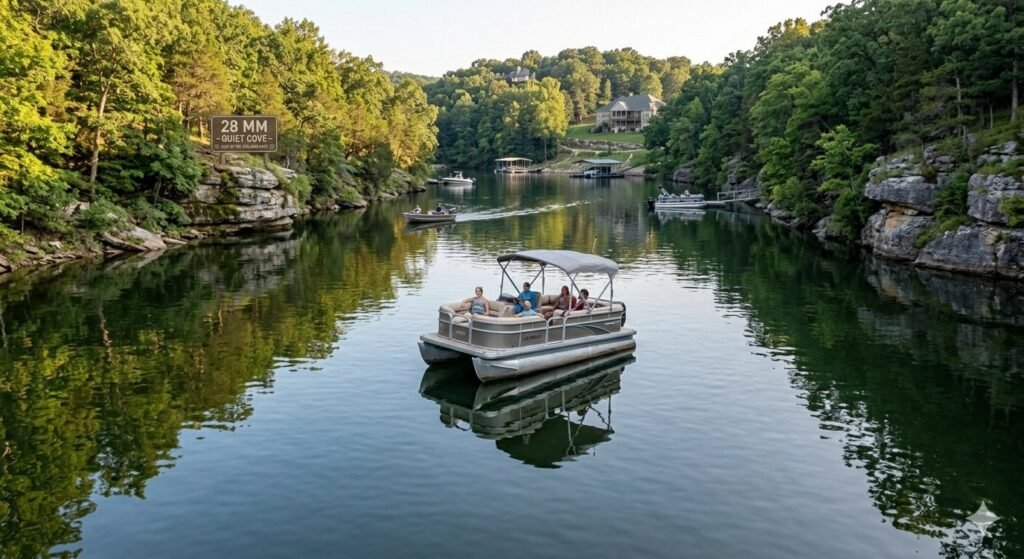
The coves and arms of Lake of the Ozarks are naturally sheltered. Trees, bluffs, and the narrower geometry of cove entrances break up wind and reduce the fetch that allows waves to build. Water in most coves remains relatively calm even on days when the main channel is choppy. Many coves feel like an entirely different lake compared to the main channel on the same afternoon.
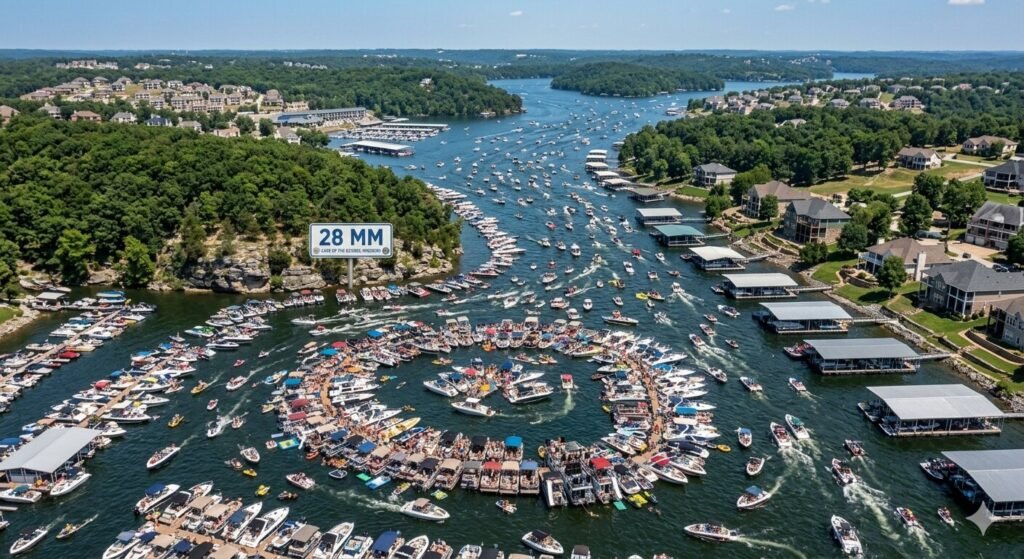
The main channel has none of that natural protection. Wind can travel uninterrupted across the full width of the channel and build a wave pattern over a long stretch of open water. Boat traffic amplifies this significantly. On a busy summer weekend at Lake of the Ozarks, the main channel handles an enormous volume of vessels. High-powered ski boats, wake boats, pontoons, jet skis, and luxury yachts all share the same channel. Every one of those vessels creates wake. The cumulative effect of constant multi-directional wake on the main channel creates a confused chop that is fundamentally different from the wave patterns you encounter in open ocean or on calmer lakes.
That confused chop is what catches small boat operators off guard. It does not come from one direction. It comes from every direction simultaneously as wakes from multiple vessels cross and intersect. A wave pattern you can read and prepare for is manageable. A confused cross-chop that hits you from multiple angles at unpredictable intervals is a different challenge entirely.
When Is the Main Channel Rough and When Is It Manageable
The main channel at Lake of the Ozarks is not consistently rough. Conditions change dramatically depending on the time of day, the day of the week, the season, and weather patterns. Understanding when conditions are favorable and when they are not is the key to navigating the main channel safely in a smaller vessel.
Early morning hours are consistently the calmest time on the main channel. Before the majority of recreational traffic launches for the day, the channel is quiet. Wind tends to be lighter in the morning before afternoon thermal patterns develop. The water surface on a calm morning at Lake of the Ozarks can be genuinely glassy. This is the window that experienced small boat operators on this lake use intentionally. If you have a smaller vessel and you want to cross the main channel or cruise along it, early morning is your best opportunity.
Peak afternoon hours on a summer weekend are when the main channel reaches its most challenging conditions. From approximately 11 AM through 5 PM on a Saturday or Sunday in July or August, the channel carries its maximum traffic volume. Hundreds of vessels are operating simultaneously. The wake builds continuously and crosses from every direction. The afternoon sun also heats the land faster than the water, creating thermal wind patterns that push across the lake surface and add to the chop. This combination of heavy traffic and afternoon wind consistently produces the roughest main channel conditions of the week.
Weekday conditions are significantly more favorable than weekend conditions regardless of the time of day. During the week, especially Monday through Thursday, boat traffic on Lake of the Ozarks drops dramatically compared to peak weekend volume. The main channel is navigable for smaller vessels much more comfortably on a Tuesday afternoon than it would be on a Saturday morning of a holiday weekend. If your schedule has any flexibility, weekday outings offer a meaningfully calmer main channel experience.
Holiday weekends represent the most extreme conditions on the main channel. Memorial Day weekend, Fourth of July weekend, and Labor Day weekend are the peak traffic events of the Lake of the Ozarks season. The lake draws enormous crowds during these periods. The main channel traffic volume on a Fourth of July afternoon is unlike anything you encounter on a normal summer weekend. Small boat operators who are not experienced with high-traffic lake conditions should avoid the main channel entirely during peak holiday weekend afternoon hours.
Weather-driven conditions operate independently of traffic patterns. Lake of the Ozarks sits in Missouri where afternoon thunderstorms develop quickly and move fast in summer months. A morning that looks perfectly calm can produce dangerous conditions by early afternoon as storm systems build. Wind can shift direction and increase speed rapidly ahead of a storm. The main channel, with its wide open exposure, responds to wind-driven wave patterns faster than any other section of the lake. Monitoring a marine weather forecast before you launch and throughout your time on the water is essential for safe main channel navigation regardless of boat size.
What Boat Sizes and Types Handle the Main Channel Well
Not all small boats are equal when it comes to handling the Lake of the Ozarks main channel. The relationship between boat size, boat design, and channel conditions is more nuanced than a simple size cutoff.
Length matters but it is not the only factor. A longer boat generally handles chop better than a shorter one because its hull spans multiple wave intervals simultaneously, which smooths the ride. A 24-foot pontoon handles main channel conditions more confidently than a 16-foot aluminum fishing boat. But a 24-foot pontoon with a flat-bottom hull design is still going to pound through cross-chop in a way that a 24-foot V-hull runabout will not.
Hull design is critically important. Flat-bottom boats and pontoons sit on top of the water rather than cutting through it. They are extremely stable in calm water but they slap and bounce through chop in a way that is uncomfortable and potentially unsafe at higher speeds. A deep V-hull design cuts through waves rather than riding over them. It handles confused chop significantly better than a flat-bottom or modified V design. For consistent main channel navigation at Lake of the Ozarks, a deeper V-hull gives you a meaningful advantage.
Pontoon boats deserve specific discussion because they are among the most popular vessels on Lake of the Ozarks. Standard pontoons handle moderate main channel conditions reasonably well at appropriate speeds. The key is reducing speed in chop rather than trying to power through it. A pontoon that is cruising at a sensible pace through moderate chop is comfortable and controllable. The same pontoon trying to maintain full speed through confused afternoon wake is uncomfortable for passengers and harder to control. Tritoon designs, with a third pontoon tube in the center, handle chop better than standard two-tube pontoons and are generally a smarter choice for operators who plan to spend meaningful time on the main channel.
Very small boats, typically under 16 feet, require genuine caution on the Lake of the Ozarks main channel during peak conditions. A small aluminum fishing boat or a basic runabout under 16 feet can be completely manageable on the channel during calm early morning hours with light traffic. The same boat on a Saturday afternoon in peak season on the main channel is in a challenging and potentially dangerous environment. The wake from a large wake boat or a passing yacht can be genuinely hazardous to a very small vessel that does not have the hull length and freeboard to handle it safely.
Personal watercraft and jet skis handle the main channel conditions differently because of how they are designed and operated. They are agile and can navigate around wake patterns. Experienced jet ski riders handle main channel conditions confidently. However, jet skis have very low freeboard and take on water easily in rough conditions. Less experienced riders on jet skis in heavy chop are at real risk of capsizing or losing control. Jet ski operation on the main channel requires genuine experience and conservative speed management in rough conditions.
Practical Safety Rules for Small Boats on the Main Channel
If you are operating a smaller vessel on the Lake of the Ozarks main channel, specific practical rules make the difference between a safe crossing and a dangerous situation.
Reduce your speed in chop. This is the single most important rule. Speed amplifies the effect of rough water on a small boat. A small vessel hitting chop at full throttle pounds hard, loses control inputs, and becomes uncomfortable and dangerous quickly. Reducing speed gives your hull time to respond to each wave rather than slamming into them. It is counterintuitive for some operators who think that going faster gets them through the rough section quicker. The physics do not support that approach. Slower is safer in chop.
Head into the waves at an angle. When crossing a confused chop pattern on the main channel, angling your bow slightly into the dominant wave direction rather than taking waves directly on the beam gives you better control. A beam sea, where waves hit you directly from the side, is the most destabilizing orientation for a small flat-bottom or pontoon vessel. Adjusting your heading by 20 to 30 degrees to take waves more head-on improves stability significantly.
Give large vessels maximum clearance. Large yachts, pontoons with multiple motors, and wake boats produce significant wake even at idle or slow speeds. Their displacement moves water. When a large vessel passes you on the main channel, turn your bow toward their wake and reduce speed. Take the wake head-on rather than letting it hit you from the side. Maintain as much distance as the channel allows. A wake that looks small from 200 feet away grows significantly as it reaches a small vessel close up.
Know your no-wake zones and use them. The Lake of the Ozarks main channel has designated no-wake zones in specific areas. Near marinas, near docks, near designated swim areas, and near certain congested sections, no-wake rules apply. In these areas all vessels must idle at minimum speed. For a small boat operator, no-wake zones provide temporary relief from the chop generated by fast-moving traffic. Plan your route to take advantage of no-wake zones when conditions on the open channel are challenging.
File a float plan before you go. Tell someone on shore where you are launching from, where you plan to go, and when you expect to return. If you get into difficulty on the main channel and cannot call for help, a float plan means someone knows to alert Missouri State Water Patrol if you do not check in. This step takes five minutes and can save your life in a genuine emergency. The Missouri State Water Patrol actively patrols Lake of the Ozarks and responds to boater distress situations.
Carry all required safety equipment. Life jackets for every person on board must be properly fitted and immediately accessible. A working horn or sound signal device is required. Visual distress signals should be on board for any crossing in reduced visibility conditions. A fully charged phone and if possible a handheld VHF radio give you communication options if you need assistance on the main channel. None of this equipment helps you if it is buried in a storage compartment when you need it. Keep it accessible.
The Coves as Your Alternative to the Main Channel
One of the most valuable things a first-time Lake of the Ozarks boater can understand is that the coves are not a consolation prize for avoiding the main channel. They are genuinely spectacular destinations in their own right.
The coves at Lake of the Ozarks offer calm, protected water in almost any conditions. They are sheltered from wind and from the main channel wake. Water in most coves is smooth and clear. The swimming is excellent. The scenery is beautiful. Anchoring in a well-chosen cove gives you a peaceful and private experience that the busy main channel never provides.
Many of the most memorable Lake of the Ozarks experiences happen entirely in the coves. Quiet morning anchorages in the upper arms near Gravois Mills, Lynch Hollow, and the Hurricane Deck area offer a version of this lake that feels completely different from the high-energy main channel scene. These coves are accessible through short stretches of the main channel early in the morning when conditions are calm.
A practical strategy for small boat operators is to plan your main channel crossings for early morning, use the coves as your primary operating area throughout the day, and return via the main channel in the early evening before peak afternoon traffic fully subsides. This approach gives you access to the full lake while limiting your exposure to the most challenging main channel conditions of the day.
Party Cove near Mile Marker 28 is accessed via the main channel. But the cove itself is protected and calm for anchoring. Getting there requires a main channel run from wherever you are launching. Plan that run for early morning or accept that afternoon conditions on the transit will require slower speed and more careful navigation.
Why a Captained Charter Solves the Main Channel Question Entirely
If the main channel conditions on Lake of the Ozarks give you genuine pause, the simplest solution is to book a captained charter with Yacht Rental Lake Ozark. A captained charter puts a licensed, experienced professional at the helm. That professional has navigated the main channel in every condition this lake produces. They know when to push through and when to slow down. They know how to position the vessel relative to passing boats. They know the no-wake zones, the wave patterns, and the traffic flow.
You do not have to worry about whether your boat can handle the main channel. Your captain handles the main channel. You handle enjoying the view from the deck of a properly sized and properly operated luxury vessel.
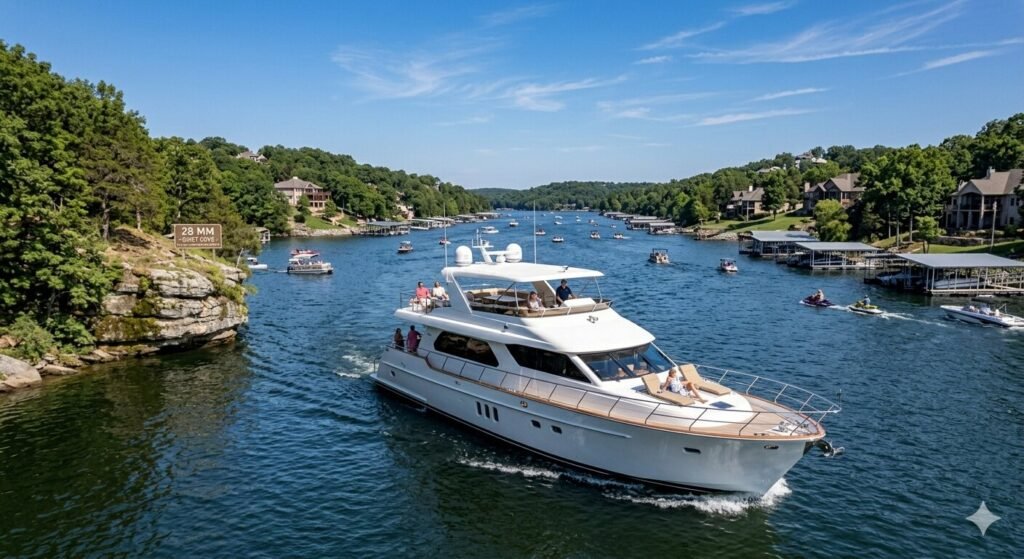
Larger charter vessels are also simply better suited to main channel conditions than small rental boats. A luxury yacht or a full-size tritoon has the hull length, freeboard, and power to navigate main channel conditions comfortably in situations where a smaller rental boat would be uncomfortable or unsafe. The vessel design and the captain’s experience together create an experience where the main channel is not a challenge. It is simply the path to wherever your group wants to go.
For families with children, guests who are not experienced boaters, or anyone who wants to fully enjoy a day on Lake of the Ozarks without managing navigation decisions, a captained charter removes every concern about main channel conditions from the equation. You are in good hands from departure to return.
Frequently Asked Questions
Is the Lake of the Ozarks main channel always rough for small boats?
No. Main channel conditions vary significantly based on time of day, day of the week, season, and weather. Early morning hours on weekdays during the shoulder season offer the calmest conditions. Peak afternoon hours on summer holiday weekends produce the most challenging conditions. Small boat operators who understand these patterns can navigate the main channel safely by choosing their timing carefully.
What is the minimum safe boat size for the Lake of the Ozarks main channel?
There is no fixed minimum size that applies universally. Conditions matter as much as size. A well-designed 18-foot runabout with a deep V-hull can handle moderate main channel conditions capably. A 20-foot flat-bottom pontoon may struggle in the same conditions. Hull design, freeboard, and operator experience are all factors alongside length. As a general guideline, boats under 16 feet should avoid the main channel during peak traffic periods and use it only in calm early morning conditions with an experienced operator.
What time of day is the Lake of the Ozarks main channel calmest for small boats?
Early morning is consistently the calmest time on the main channel. Before the majority of recreational traffic launches, typically before 9 AM, the channel has minimal wake and lower wind. If you are operating a smaller vessel and need to cross or cruise the main channel, plan that segment for the early morning window.
Are pontoon boats safe on the Lake of the Ozarks main channel?
Standard pontoons are manageable on the main channel in moderate conditions when operated at appropriate speeds. Reducing speed in chop is essential. Tritoon designs handle main channel conditions better than standard two-tube pontoons due to the added center tube. During peak afternoon hours on busy weekends, any pontoon should reduce speed significantly on the main channel and be prepared for confused cross-chop from multiple directions.
What should I do if conditions on the main channel become too rough for my small boat?
Reduce speed immediately. Turn your bow into the dominant wave direction. Head for the nearest cove entrance where conditions will be calmer. Do not try to power through conditions that feel unsafe. It is always better to wait in a protected cove for conditions to improve than to push through a rough main channel in an undersized or underpowered vessel. Contact Missouri State Water Patrol if you need assistance.
Does boat traffic create worse conditions than wind on the Lake of the Ozarks main channel?
Both contribute significantly and they often compound each other. On a calm windless day, heavy boat traffic alone generates enough confused wake on the main channel to create challenging conditions for small boats. When wind is added to heavy traffic, conditions worsen considerably. Peak summer weekend afternoons combine maximum traffic with typical afternoon wind increases, producing the most difficult combination of conditions on the main channel throughout the season.
Are jet skis safe on the Lake of the Ozarks main channel?
Experienced riders handle the main channel on jet skis confidently. The agility of a jet ski allows an experienced operator to navigate around wake patterns effectively. However, jet skis have low freeboard and are vulnerable to taking on water in rough conditions. Less experienced riders should avoid the main channel during peak conditions and stick to calmer coves until they have built confidence and skill on the water.
Is a captained charter a better option than a small boat rental for main channel navigation?
For most visitors to Lake of the Ozarks, yes. A captained charter puts a licensed professional at the helm of an appropriately sized vessel. The captain handles all main channel navigation decisions. Guests experience the full lake comfortably and safely without managing any of the navigation challenges themselves. For families, groups celebrating special occasions, and anyone who is not an experienced boater, a captained charter from Yacht Rental Lake Ozark delivers a superior and significantly less stressful experience compared to operating a small rental boat on the main channel independently.
Making Smart Decisions on the Lake of the Ozarks Main Channel
The main channel at Lake of the Ozarks is not inherently dangerous. It is not a place you should fear. But it demands respect and smart decision-making, especially if you are operating a smaller vessel.
Know your boat. Know its limits. Know when conditions exceed those limits. Use the early morning window when you need calm conditions for a main channel crossing. Use the coves as your primary playground throughout the day. Reduce speed when chop builds. Give large vessels the space their wake demands. Keep your safety equipment accessible and your float plan filed.
If any of that sounds like more management than you want to deal with on what is supposed to be a relaxing day on the water, the answer is straightforward. Book a captained charter with Yacht Rental Lake Ozark. Our captains navigate this main channel constantly. They know its patterns, its timing, and exactly how to deliver a smooth and enjoyable experience across every section of this lake regardless of conditions.
You should be watching the bluffs and enjoying the company of your group. Let an expert handle the water.
Reach out to Yacht Rental Lake Ozark today to plan your charter. The main channel is beautiful when you experience it the right way.