
Operating a 50 foot yacht is a completely different experience from driving a small powerboat or a pontoon. The vessel is longer, heavier, and slower to respond. It has more momentum. It draws more water. It requires more room to maneuver. And when conditions on the water turn rough, every one of those characteristics demands a specific and informed response from whoever is at the helm.
Lake of the Ozarks is a stunning body of water. But it can produce genuinely challenging conditions. Afternoon thunderstorms build quickly in Missouri. Heavy boat traffic on the main channel creates confused multi-directional chop. Wind pushes across open sections of the lake without mercy. Knowing how to navigate a 50 foot yacht in rough lake water is not optional knowledge for a captain on this lake. It is essential.
This guide covers everything. Throttle management, wave angle techniques, crew and passenger safety, storm preparation, and the judgment calls that experienced captains make before conditions ever become dangerous. Whether you are a captain developing your skills or a guest who wants to understand what good yacht handling looks like, this guide gives you the full picture.
Understanding How a 50 Foot Yacht Behaves Differently in Rough Water
Before you can navigate a large yacht through rough conditions, you need to understand how it responds differently from smaller vessels. This understanding is the foundation of every decision you make at the helm.
A 50 foot yacht carries significant displacement. It weighs far more than any small recreational boat on Lake of the Ozarks. That weight creates inertia. When you reduce throttle, the vessel does not stop quickly. When you adjust your heading, the bow swings slowly compared to a small runabout. Everything happens on a larger scale and on a longer timeline. A captain who learned on small boats and moves to a 50 foot vessel without proper transition training will consistently underestimate how much space and time every maneuver requires.
Hull design on a large yacht is built to handle rough water better than flat-bottom designs. Most 50 foot yachts feature a deep V or modified V hull that cuts through wave patterns rather than riding over them. This is a significant advantage in choppy conditions. The hull is designed to part water efficiently at the bow and track stably through the chop. However, that advantage only works when the vessel is trimmed correctly and operated at the right speed for conditions. Pushing a 50 foot yacht too fast through rough lake water eliminates the hull’s natural advantage and creates a pounding ride that stresses both the vessel and the passengers.
Draft is another critical consideration on Lake of the Ozarks specifically. A 50 foot yacht draws considerably more water than a pontoon or small powerboat. Typical draft on a vessel this size ranges from 3 to 5 feet depending on the specific design. Lake of the Ozarks has shallow sections, particularly in the upper arms and near cove entrances. Rough conditions that push a large yacht off the main channel toward shallower water create a grounding risk that a smaller vessel would not face. Knowing the draft of your specific vessel and keeping a depth finder active at all times is non-negotiable on this lake.
Windage is the effect of wind acting on the above-water portion of the vessel. A 50 foot yacht has a significant profile above the waterline. Cabin structures, flybridge if present, and the overall height of the vessel present a large surface to wind. In crosswind conditions, the wind pushes the vessel sideways in a way that requires constant helm correction. In strong winds on Lake of the Ozarks, this windage effect is pronounced and demands active steering management throughout the transit.
Reading Conditions Before You Leave the Dock
The single best rough water navigation technique available to any yacht captain is avoiding rough water in the first place. That requires reading conditions accurately before departure and making disciplined decisions about whether to go out, when to go out, and what route to take.
Check the marine weather forecast before every departure on Lake of the Ozarks. The National Weather Service provides lake-specific forecasts that are significantly more accurate than general smartphone apps. Look for wind speed and direction, wave height estimates, and any storm system activity within 200 miles. At Lake of the Ozarks, afternoon thunderstorms are a consistent summer pattern. Morning forecasts often look clear and conditions deteriorate rapidly by early afternoon. A forecast showing developing storm activity by 2 PM is a signal to either depart early and return before that window or reschedule the trip entirely.
Read the sky actively throughout the day. Weather at Lake of the Ozarks can change faster than forecast updates. Developing cumulus clouds building vertically on the horizon are a reliable early warning of storm activity. A darkening sky to the southwest is the most common storm approach direction in Missouri. When you see that darkening beginning, you typically have 30 to 60 minutes before conditions deteriorate significantly. That window is enough time to reach a marina or a sheltered cove if you act on it immediately rather than waiting to see how it develops.
Observe the water surface itself as you cruise. Ripples and small whitecaps on open sections of the lake indicate wind that will build wave patterns over time. If the main channel is showing whitecaps when you depart, expect conditions to worsen rather than improve as the afternoon progresses. Calm water on the protected arms does not always reflect what the main channel is doing. Cross from the coves to the main channel and assess actual conditions there before committing to a long transit.
Talk to other captains and marina staff. Local knowledge is invaluable on Lake of the Ozarks. Captains who have been out earlier in the day have real-time information about what the main channel conditions are like. Marina staff often track weather and lake conditions throughout the day. A quick conversation at the fuel dock can give you information that no forecast app provides.
Throttle Management and Speed Control in Rough Conditions
Throttle management is the most fundamental rough water navigation skill. Get this right and everything else becomes more manageable. Get it wrong and rough conditions become dangerous faster than you expect.
Slow down before conditions require it. This is the principle that separates experienced captains from those still developing their judgment. Do not wait until you are pounding through chop to reduce throttle. Reduce speed proactively as soon as wave patterns begin building. A 50 foot yacht at reduced speed in developing chop handles the transition to rough conditions smoothly. The same vessel hitting developed rough conditions at full cruise speed absorbs significant stress and becomes harder to control.
Find the speed that works with the waves, not against them. In regular wave patterns, experienced captains find a speed that allows the hull to rise with each wave and settle into the trough in a controlled rhythm. This is sometimes called riding the seas. The hull climbs the face of an oncoming wave, crests it, and descends into the following trough in a predictable cycle. Finding the right speed for that rhythm on a 50 foot yacht takes feel and practice. Too fast and you are airborne off wave crests. Too slow and you lose steering authority as the bow pitches down into each trough.
In confused cross-chop conditions, which is the typical pattern on the Lake of the Ozarks main channel during heavy traffic, there is no regular wave rhythm to work with. Waves come from multiple directions simultaneously. In this scenario, moderate speed with active helm management is the correct approach. You are not riding regular seas. You are managing continuous irregular inputs from multiple directions. Reduced speed gives you more response time to each wave hit and more control authority between wave intervals.
Avoid sudden throttle changes in rough conditions. Sudden acceleration or sudden deceleration on a large yacht in rough water creates vessel behavior that passengers and crew are not braced for. Acceleration pitches the bow up. Sudden deceleration pitches the bow down. In rough conditions both movements are exaggerated and can throw unsecured passengers off their feet. Make all throttle changes smooth and gradual. Plan ahead for speed changes so they happen predictably rather than reactively.
Wave Angle Techniques for a 50 Foot Yacht
The angle at which your vessel meets wave patterns is the second most critical rough water navigation variable after throttle management. Hull design advantages only work when the vessel is presented to the waves correctly.
Taking waves at the bow is the preferred approach for a 50 foot yacht in regular ocean-style swells or developed lake waves. Meeting waves head-on at the bow allows the deep V hull to part the water cleanly, the vessel rises on the wave face and descends the back side in a controlled motion. This is the most comfortable and most controlled orientation for running through regular wave patterns in a large yacht.
A slight quartering angle is often more practical than dead head-on in real-world rough water navigation on Lake of the Ozarks. Running at approximately 10 to 20 degrees off the bow to the wave face allows the hull to work through the wave while reducing the pitching motion that a perfectly head-on approach creates. This slight quartering angle smooths the ride meaningfully without sacrificing control. Experienced captains find this angle instinctively based on the specific wave pattern they are encountering.
Beam seas are the most dangerous orientation for any large vessel in rough conditions. A beam sea means waves are hitting you directly from the side, perpendicular to your heading. In a large yacht, beam seas create a rolling motion that can become severe in significant wave heights. If you find yourself in a beam sea situation on Lake of the Ozarks, alter course immediately. Turn your bow toward the wave source even if it takes you temporarily off your planned route. Getting the waves on your bow or quarter is always preferable to taking them on the beam.
Following seas require specific management on a 50 foot yacht. When waves are running in the same direction you are traveling, there is a risk of the following sea pushing the stern faster than the bow is moving, which causes the vessel to yaw or broach. In a following sea, reduce speed to stay behind the wave crest rather than surfing down the wave face. Maintain active steering correction to keep the bow tracking straight. A 50 foot yacht in a severe following sea that is not managed correctly can swing broadside to the waves quickly.
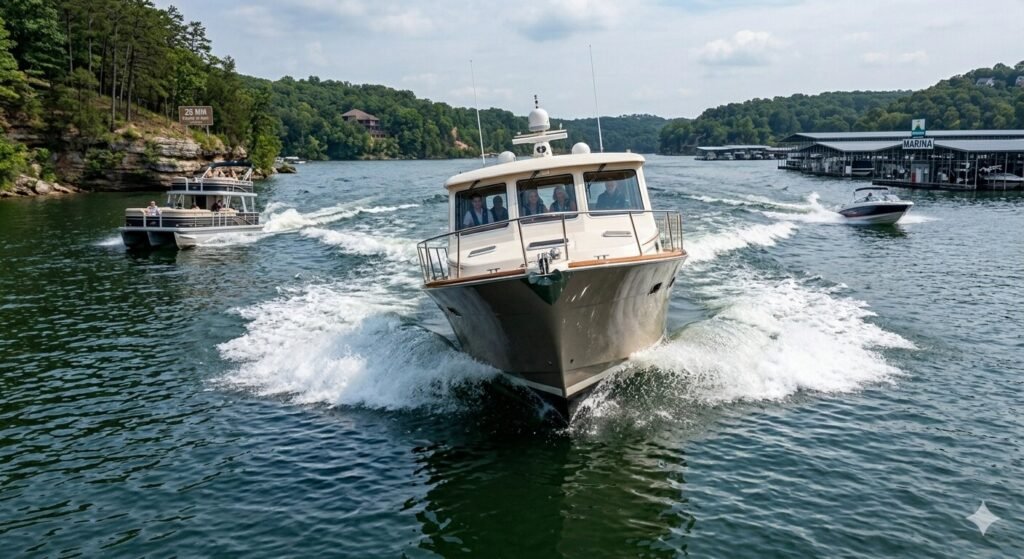
Crossing wakes from other vessels is a specific challenge on the Lake of the Ozarks main channel. Large wakes from passing boats are predictable in their approach. Watch for approaching vessel wakes well ahead. Reduce speed as the wake approaches. Meet the wake at a slight bow angle rather than on the beam. Do not try to outrun a wake from a vessel moving in the opposite direction. The closing speed makes that impossible. Slow down, angle in, and take it at the bow.
Crew and Passenger Management in Rough Conditions
On a 50 foot yacht in rough water, managing the people on board is as important as managing the vessel. Passengers who are not properly briefed and positioned in rough conditions are a safety risk to themselves and a distraction to the captain.
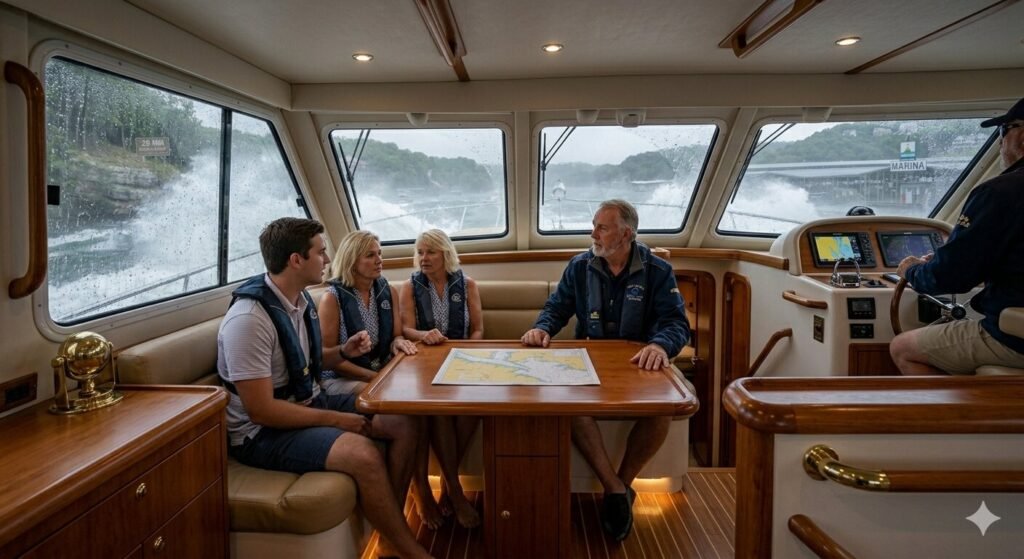
Brief your passengers before conditions develop. Do not wait until the yacht is already in rough water to explain what passengers should do. Brief everyone at departure or at the first sign of developing conditions. Explain the importance of staying seated. Explain where handholds are located throughout the vessel. Explain that they should not move around the deck without alerting crew and without holding on continuously. Explain what to do if someone goes overboard. A passenger who understands what to expect in rough conditions stays calmer and safer than one who is caught completely off guard.
Instruct all passengers to sit down and stay down when conditions become rough. Standing passengers on a pitching vessel are at serious risk of falls. Falling on a wet deck aboard a pitching 50 foot yacht can result in serious injury. Make it a clear instruction rather than a suggestion. All passengers sit. All passengers hold on. No movement on deck without crew assistance.
Assign a crew member specifically to passenger management if your crew size allows it. On a full service crewed charter from Yacht Rental Lake Ozark, crew members are positioned throughout the vessel to assist and monitor passengers during challenging conditions. A passenger who is becoming seasick needs attention before they are vomiting overboard over a pitching rail. A passenger who is anxious needs calm reassurance and guidance to a stable seating position below deck or in the cockpit. Dedicated crew attention to passenger welfare in rough conditions prevents minor situations from becoming serious ones.
Secure all loose items on deck and below before conditions develop or as soon as they begin. Bottles, glasses, equipment, and personal items become projectiles in rough conditions. A water bottle rolling across a wet deck and hitting a passenger’s ankle while they are bracing against the motion creates an unnecessary injury. Everything should be stowed or secured before rough conditions arrive. This is a standard preparation step that experienced captains build into their pre-departure and condition-monitoring routine.
Monitor for seasickness continuously. Seasickness can develop surprisingly quickly in rough conditions on a large yacht, even in people who have not experienced it before. A passenger who is pale, quiet, and not engaging with the group is often in the early stages of motion sickness. Address it early. Move them to an outside deck area where the horizon is visible. Give them fresh air. Position them amidships where vessel motion is minimized. Have seasickness bags accessible throughout the vessel. Early intervention prevents a manageable discomfort from becoming a miserable experience.
Storm Response Procedures on a 50 Foot Yacht at Lake of the Ozarks
Storms on Lake of the Ozarks can develop faster than any weather app will warn you. Having a clear storm response procedure that everyone on the vessel understands is the mark of a professional captain.
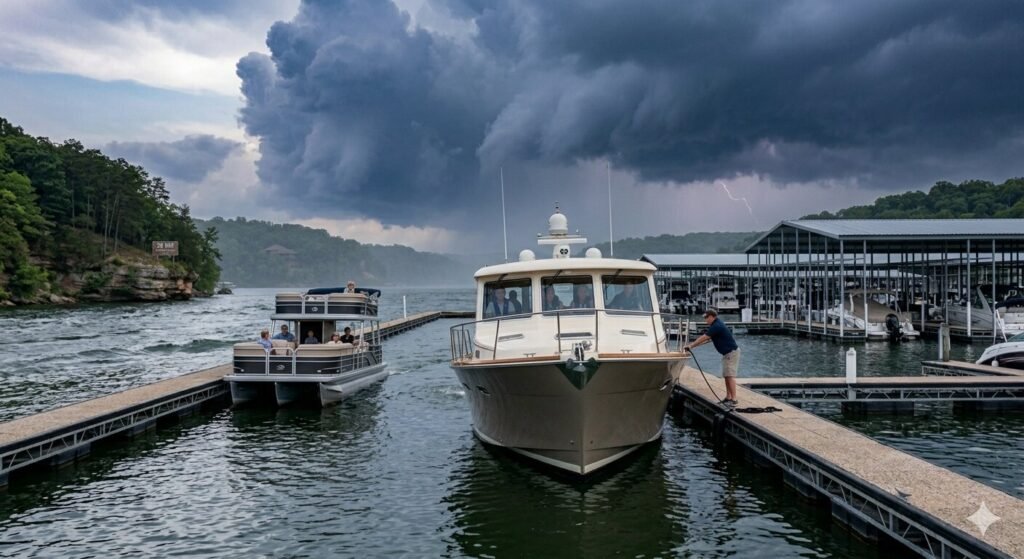
The moment storm conditions appear likely, begin moving toward shelter. Do not debate whether the storm will hit you. Do not wait for rain to start. At the first clear sign of developing storm conditions including darkening skies, freshening wind, and shifting cloud formations, begin your transit toward the nearest marina or deeply protected cove. A 50 foot yacht does not move quickly. Give yourself adequate lead time to reach shelter before conditions deteriorate.
Lightning is the highest priority threat on Lake of the Ozarks during storms. A large yacht with aluminum mast structures, antennas, and metal hardware is a significant lightning attraction on open water. Getting the vessel and all passengers under a marina roof or into a deeply protected cove before lightning is overhead is the only acceptable storm response. Do not remain on open water in a lightning storm on any size vessel under any circumstances.
Reduce speed in storm-driven rough water to what is needed for steerage only. Maintain just enough throttle to hold your heading and make controlled progress toward shelter. Operating at higher speeds in storm-driven wave conditions on a 50 foot yacht accelerates hull stress and makes the motion harder to manage for both the captain and passengers.
Make a distress call on VHF Channel 16 if the vessel is in danger and shelter cannot be reached. Missouri State Water Patrol monitors this channel and responds to distress situations on Lake of the Ozarks. Provide your vessel name, your position by nearest mile marker, the nature of your emergency, and the number of persons on board. Make this call early if conditions are deteriorating faster than your progress toward shelter.
Why a Professional Captain Makes All the Difference
Everything in this guide represents knowledge and judgment that takes years of real-world experience to develop fully. Reading about wave angle techniques is not the same as having made those heading adjustments hundreds of times in actual rough water conditions on Lake of the Ozarks.
A USCG certified captain from Yacht Rental Lake Ozark brings that depth of real experience to every charter. They have navigated the main channel in summer storms. They have read the sky correctly and reached shelter before conditions deteriorated. They have managed panicking passengers and kept everyone calm and safe. They have found the throttle setting that works with a specific wave pattern and held it steady while communicating reassurance to guests who had never experienced rough lake conditions before.
That experience is not transferable through reading alone. It is accumulated through time on this specific lake in every condition the lake produces. When you charter a captained yacht through Yacht Rental Lake Ozark, you get that accumulated expertise at the helm. You get a professional who has already made the judgment calls described in this guide dozens or hundreds of times. You get the confidence of knowing that whoever is at the helm of your 50 foot yacht on Lake of the Ozarks has genuinely earned the right to be there.
For guests who want to develop their own large vessel skills, learning from a professional captain on a Lake of the Ozarks charter is one of the most effective ways to build that knowledge. Watch how the captain adjusts throttle before conditions require it. Watch the heading adjustments as wakes approach. Watch how they brief the crew and passengers when conditions begin developing. That observation is worth more than any guide.
Frequently Asked Questions
Is a 50 foot yacht safer than a smaller boat in rough water at Lake of the Ozarks?
Generally yes. A 50 foot yacht has more hull length, more displacement, deeper V hull design, and more stability than a small powerboat or pontoon in rough conditions. Its weight and hull geometry handle confused chop and wave patterns more comfortably. However, size alone does not guarantee safety. Proper throttle management, correct wave angles, and an experienced captain are all essential regardless of vessel size.
What speed should a 50 foot yacht travel in rough lake conditions?
There is no fixed speed that applies universally. The correct speed is the one that allows the hull to work through wave patterns in a controlled rhythm without pounding or losing steering authority. In practice this usually means a significant reduction from normal cruising speed. The captain reads the specific conditions and finds the speed that works with the wave pattern rather than against it. Smooth gradual throttle management is always preferable to reactive speed changes.
What is the most dangerous wave orientation for a 50 foot yacht?
Beam seas are the most dangerous. Waves hitting directly from the side create rolling motion that can become severe and in extreme conditions can threaten vessel stability. If you find yourself in a beam sea on Lake of the Ozarks, alter course to bring waves onto the bow or quarter immediately even if it takes you temporarily off your planned heading.
How do I handle large wakes from other boats in the Lake of the Ozarks main channel?
Monitor approaching vessels continuously. Reduce speed as their wake approaches your position. Turn your bow toward the wake at a slight angle rather than taking it on the beam. Do not attempt to outrun an approaching wake from a vessel moving toward you. The closing speed makes that impossible. Slow down, angle in, and take the wake at the bow in a controlled manner.
When should a captain on Lake of the Ozarks seek shelter during a storm?
At the first clear sign of developing storm conditions. Do not wait for rain or lightning. Darkening skies, freshening wind, and building cumulus clouds are the signals to begin moving toward shelter immediately. A 50 foot yacht is not fast. Give yourself significant lead time to reach a marina or protected cove before conditions deteriorate to a dangerous level.
How do I manage seasick passengers on a 50 foot yacht in rough conditions?
Move affected passengers to an outside deck area with a clear view of the horizon. Position them amidships where motion is minimized. Provide fresh air and encourage them to focus on a fixed distant point rather than looking at the deck or interior surfaces. Have seasickness bags accessible. In severe cases, the fastest remedy is reaching calmer water. Diverting to a protected cove is always the right call when a passenger is significantly unwell.
Do I need a USCG license to operate a 50 foot charter yacht on Lake of the Ozarks?
Yes. Any captain operating a vessel for hire and carrying paying passengers on Lake of the Ozarks must hold a valid USCG captain’s license appropriate for the vessel type and passenger count. Operating a charter without a valid license violates federal maritime law and Missouri state boating law. At Yacht Rental Lake Ozark, all captains hold valid USCG credentials appropriate for their specific vessel.
What is the most important rough water navigation skill for a large yacht captain?
Proactive judgment is the most important skill. The ability to read developing conditions accurately and make course and speed decisions before rough water arrives is more valuable than any reactive technique. Experienced captains on Lake of the Ozarks do not navigate through the worst conditions. They read the lake and the sky well enough to avoid being caught in them in the first place.
The Skill and Judgment That Makes Rough Water Navigation Safe
Navigating a 50 foot yacht in rough lake water is not about bravery. It is not about pushing through conditions to prove a point. It is about deep familiarity with the vessel, accurate reading of conditions, disciplined throttle management, correct wave angle techniques, proactive passenger management, and the judgment to know when shelter is the right choice regardless of what the original plan was.
Lake of the Ozarks rewards captains who respect it. The lake is beautiful. It is expansive. It produces some of the most memorable boating experiences in the entire Midwest. It also demands competence and situational awareness from whoever is at the helm of a large vessel on its waters.
Every captain at Yacht Rental Lake Ozark brings that competence to every charter. They have navigated this lake in conditions that tested everything described in this guide. They have made the right calls. They have delivered guests safely and comfortably across every section of Lake of the Ozarks in every season. That is what you get when you book a captained charter with our team.
Reach out to Yacht Rental Lake Ozark today to plan your experience on the water. Whether conditions are glassy or challenging, you will be in the hands of someone who knows exactly what to do.