
Lake of the Ozarks is one of the busiest recreational lakes in the United States. On a peak summer weekend, thousands of vessels are on the water simultaneously. High-powered ski boats, wake boats, pontoons, jet skis, and luxury yachts all share the same channel. Every one of those vessels creates wake. That wake travels across the lake in every direction and eventually reaches every anchored vessel on the water.
Wake damage to an anchored yacht is a real concern on Lake of the Ozarks. It ranges from minor inconveniences like spilled drinks and knocked-over items to serious problems like hull-to-hull contact with other anchored vessels, anchor drag, and in worst-case scenarios, structural damage from repeated high-energy wake impacts.
The good news is that wake damage when anchoring a yacht at Lake of the Ozarks is almost entirely preventable. The right cove selection, the right anchor setup, the right fender deployment, and the right situational awareness together create a protected anchoring situation that handles even the busiest lake traffic without incident. This guide covers every one of those elements in depth.
Understanding Wake Behavior at Lake of the Ozarks
Before you can protect your anchored vessel from wake, you need to understand how wake behaves on this specific lake. Lake of the Ozarks wake patterns are different from those on a smaller lake or on open coastal water.
The main channel at Lake of the Ozarks generates the highest volume and most varied wake patterns on the lake. Every vessel passing through the main channel creates a wake that radiates outward in both directions from the vessel’s path. A large wake boat at speed generates waves that can travel hundreds of feet from the source. A fast-moving pontoon creates a V-shaped wake that fans out across the full width of the channel. When multiple vessels are operating simultaneously in the same channel section, their wakes intersect and create a confused cross-chop pattern that hits anchored vessels from multiple directions at unpredictable intervals.
Coves off the main channel receive wake in a modified form. The cove entrance acts as a filter. Wide cove entrances with direct exposure to the main channel receive nearly the full energy of passing wakes. Narrow cove entrances with offset geometry relative to the main channel significantly reduce the wake energy that penetrates into the cove interior. The shape, orientation, and depth of the cove entrance determine how much of the main channel wake energy reaches an anchored vessel inside.
Wake boats and large powered yachts generate the most damaging wake on Lake of the Ozarks. These vessels displace large amounts of water at speed and create steep-faced waves that retain their energy over significant distances. A wake boat at full speed 300 feet away from your anchored vessel can generate waves large enough to cause significant rolling motion and snap load on your anchor rode if you are not properly prepared.
Reflected wake is a phenomenon that catches many anchored boaters off guard on Lake of the Ozarks. When a wave hits a bluff face, a concrete seawall, or a steep shoreline, it does not simply stop. It reflects back across the water at an angle. An anchored vessel that is positioned between a passing wake source on the main channel and a reflective shoreline behind it receives wake energy from two directions simultaneously. Understanding the reflection geometry of your anchoring position helps you anticipate this effect and position to minimize it.
Cumulative wake loading is the sustained stress that multiple waves impose on your anchor system over time. A single large wake is manageable if your anchor is set correctly. Hours of repeated wake impacts, each pulling and releasing the anchor rode, create a cumulative loading effect that can work an improperly set anchor free of the bottom over time. This is how anchors drag without any single dramatic event triggering the failure. The anchor simply works loose gradually under repeated loading cycles.
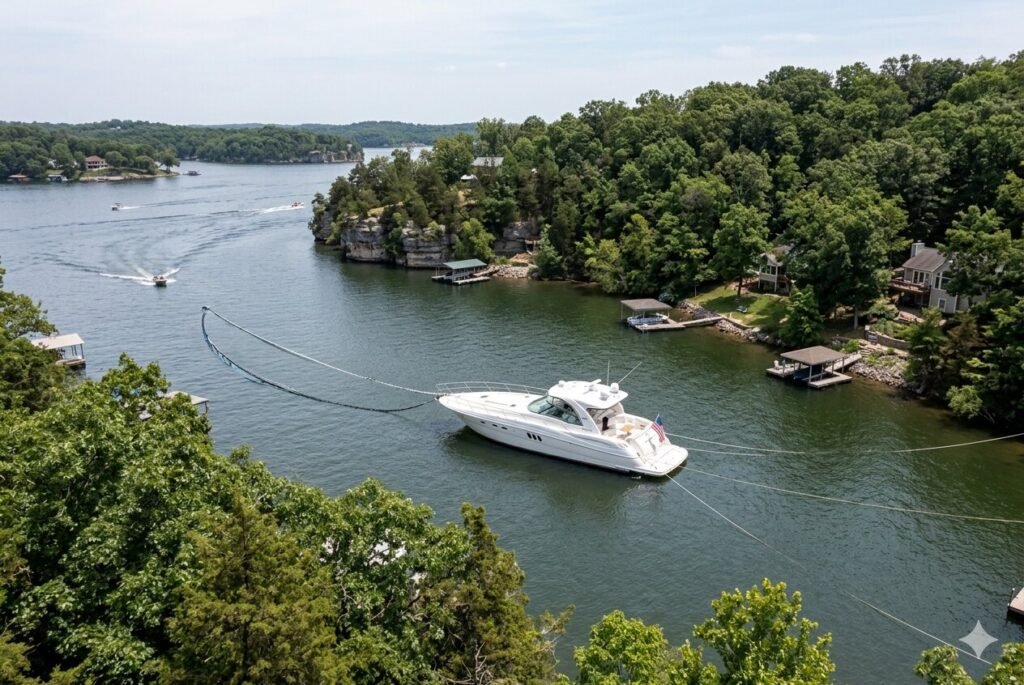
Cove Selection | Your First Line of Defense Against Wake Damage
The single most effective way to protect an anchored yacht from wake damage at Lake of the Ozarks is choosing the right cove in the first place. A well-chosen anchorage dramatically reduces the wake energy your vessel is exposed to before you deploy a single fender.
Choose coves with narrow or offset entrances. A cove whose entrance is narrow relative to its interior provides natural attenuation of incoming wake. The wake energy that passes through a narrow entrance spreads across a larger area inside the cove, reducing its height and energy by the time it reaches an anchored vessel. An offset entrance, where the cove opening faces a direction other than directly toward the main channel, provides even more protection because passing wakes must bend around the shoreline geometry to enter the cove at all.
Prioritize bluff-lined coves for maximum protection. The rock bluff formations in the Hurricane Deck area and throughout the upper mid-lake section between Mile Marker 32 and Mile Marker 42 create some of the most naturally protected anchorages on the entire lake. Bluff walls deflect wind and reduce the fetch that allows waves to build inside the cove. They also absorb rather than reflect wake energy in a different way than smooth vertical surfaces. The calm water typically found in bluff coves on Lake of the Ozarks is not accidental. It is the result of excellent natural protection that the geological features provide.
Put distance between your anchorage and the main channel. The further your anchored position is from the main channel, the more energy dissipation occurs before wake reaches you. Even 200 to 300 feet of additional distance from the cove entrance makes a measurable difference in the wave height and energy experienced at the anchoring position. In a well-shaped cove, positioning your anchor in the far interior rather than near the entrance reduces your wake exposure significantly.
Avoid coves with wide open entrances facing the busiest traffic sections. A cove that opens directly toward a section of the main channel near Osage Beach or the Mile Marker 19 through 28 corridor on a peak summer weekend is going to receive substantial wake traffic all day. The traffic in this section never fully stops on a busy summer day. Choosing a cove in a less trafficked section of the lake, or choosing a cove whose entrance geometry provides natural protection even in a busy area, delivers a fundamentally better anchoring experience.
Consider the time of day in relation to your cove choice. Even a relatively exposed cove is manageable during early morning hours when traffic is minimal. The same cove on a Saturday afternoon in peak July conditions becomes uncomfortable and potentially damaging for an anchored vessel. If your schedule puts you anchoring during peak afternoon traffic hours, be more selective about cove protection quality than you would need to be for an early morning anchoring situation.
Anchor Setup | Protecting Against Wake-Induced Drag
A correct anchor setup is your technical defense against the cumulative wake loading that gradually works a poorly set anchor free. Wake damage from anchor drag is preventable with proper setup technique from the beginning.
Use adequate scope for conditions. Standard anchoring guidance recommends a 5:1 scope ratio for calm conditions. In high-wake conditions at Lake of the Ozarks, extending scope to 7:1 is the better choice. More scope creates a lower angle of pull on the anchor, which keeps the flukes or claws pressed into the bottom more effectively under repeated wake loading. A shorter scope creates a steeper pull angle that lifts the anchor slightly with each wave impact. Over dozens or hundreds of wave cycles, that repeated lifting effect works the anchor progressively looser.
Set the anchor aggressively. After dropping your anchor and letting out proper scope, use reverse throttle to set the hook firmly before you consider the setup complete. Do not just drift back gently and assume the anchor is set. Apply meaningful reverse throttle and hold it for 30 seconds while watching your position relative to fixed shoreline landmarks. A properly set anchor does not move during this test. If you detect any position change, pull the anchor and reset it before relaxing.
Use a heavier anchor than you think you need. On Lake of the Ozarks in high-traffic conditions, undersized anchors are a consistent failure point. The cumulative wake loading described above exceeds what a marginally adequate anchor handles over an extended anchoring period. Choose an anchor rated for a vessel larger than yours. The additional weight and holding surface area provide a meaningful safety margin against wake-induced drag in busy conditions.
Consider a second anchor in extreme conditions. In high-traffic areas on peak summer weekends, deploying a second anchor at an angle to the first creates a two-point hold that significantly reduces the motion range of the anchored vessel and distributes the wake loading across two anchor systems. This is a more advanced technique but one that experienced captains use in situations where a single anchor setup will be subjected to sustained heavy wake loading. A Bahamian moor, where two anchors are set in opposite directions from the vessel, limits the vessel’s swing arc and provides redundant holding in confused multi-directional wake conditions.
Use a snubber line on chain rode. If your anchor rode includes chain, attaching a nylon snubber line between the chain and the bow cleat absorbs wake-induced shock loading before it reaches your anchor system. Nylon stretches under load and returns to its original length, acting as a shock absorber in the rode system. Without a snubber, every wake impact transmits a hard shock directly through the chain to the anchor. Over hundreds of wave cycles, that repeated shock loading fatigues the anchor hold and can cause drag in conditions that a properly dampened system would handle without issue.
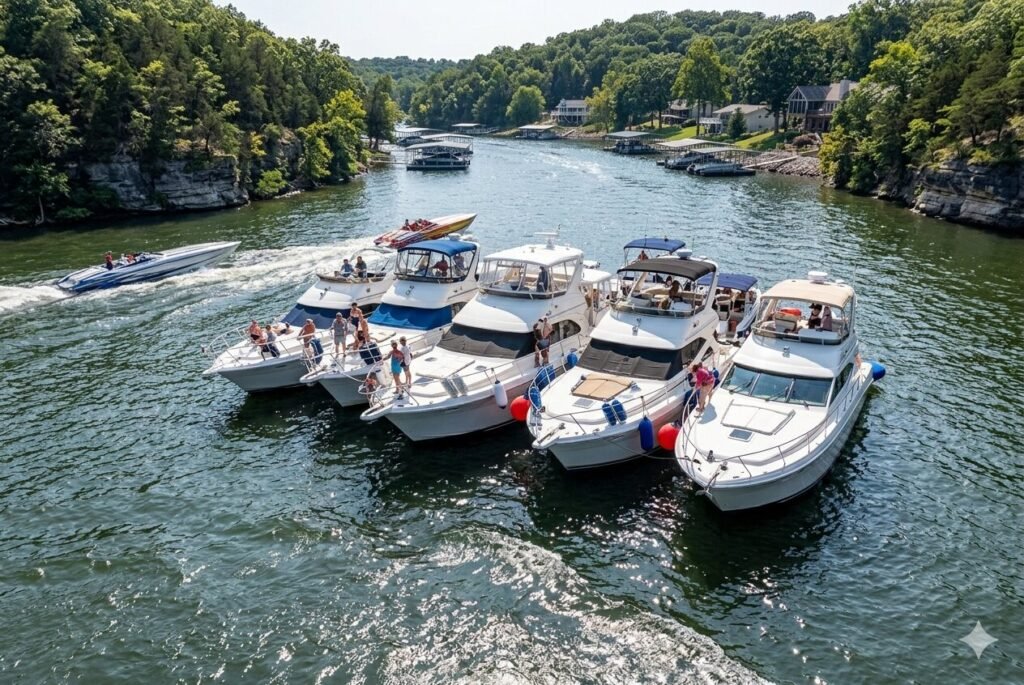
Fender Deployment and Vessel Protection While Anchored
Even in a well-chosen cove with a properly set anchor, wake can cause vessel-to-vessel contact problems when multiple boats are anchored in proximity. Fender deployment is your protection against hull damage from contact with other vessels during wake events.
Deploy fenders before you need them, not after. This sounds obvious but it is one of the most common mistakes made by recreational boaters anchoring in busy cove situations at Lake of the Ozarks. If there are other vessels anchored near you or if the cove is likely to fill with additional anchored boats during your stay, have your fenders deployed on both sides of the vessel before any contact risk develops. A wake event that causes contact before fenders are out is how hull damage happens.
Size your fenders appropriately for your vessel. Undersized fenders compress fully under contact load and allow hard contact between hulls anyway. A 50 foot yacht needs substantially sized fenders to provide genuine protection in wake conditions where two anchored vessels are swinging toward each other. Use the largest fenders your vessel carries and position them at the points of highest contact risk based on the relative position and swing pattern of nearby vessels.
Position fenders at the correct height. Fenders positioned too high protect your deck rail but leave the hull below the waterline exposed to contact at the waterline. Fenders positioned too low hang below the waterline and provide no protection at the contact zone. Correct fender height places the fender body at the waterline to hull transition zone where contact between vessels typically occurs in wave conditions. Adjust fender height based on the relative freeboard of nearby vessels.
Use fender boards when rafting with other vessels. If your charter situation involves rafting with another vessel, a fender board, which is a horizontal board that distributes load across multiple fenders, provides significantly better protection than individual fenders alone. Fender boards prevent the common situation where two vessels with curved hull sections concentrate all contact force on a single point between fenders, compressing the nearest fender and allowing hull-to-hull contact on either side of it.
Monitor fender position regularly during wake periods. Fenders that are initially at the correct height can ride up or down as vessel motion in wake conditions changes the dynamic freeboard. A fender that started at the correct position can migrate out of the contact zone during sustained wake activity. Check and readjust fender position throughout periods of heavy wake exposure rather than setting them once and assuming they stay in position.
Managing Your Anchored Vessel During Peak Wake Periods
Proper cove selection and anchor setup address the structural aspects of wake protection. Managing your vessel actively during peak wake periods addresses the dynamic aspects that develop throughout the day.
Monitor your anchor position continuously during peak traffic hours. Do not anchor and then ignore your position. Use fixed shoreline landmarks as reference points and check your position against those references regularly. A rock outcropping, a distinctive tree, or a shore structure that you noted at the time of anchoring gives you an immediate visual reference for whether your position has changed. If you notice even slight position change, investigate immediately rather than assuming it was just wave motion. Early detection of anchor drag allows you to address it before it becomes a dangerous situation.
Be aware of other vessels anchoring near you. When another vessel anchors in your vicinity, their swing arc may overlap yours. Wake events that cause both vessels to swing simultaneously can bring them into contact. If a vessel anchors closer than you are comfortable with relative to your swing arc, communicate politely and early. Most experienced boaters respond well to a calm conversation about swing arc overlap before it becomes an incident. On Lake of the Ozarks, popular coves fill quickly on peak summer days and proximity between anchored vessels is common.
Keep noise and activity levels appropriate for the anchoring situation. This is relevant to wake damage in a specific way. Guests moving quickly around the deck of an anchored yacht during wake events become a vessel stability concern. A wake that hits an anchored vessel with guests standing at the rails and moving around the deck creates a combined motion effect that is more pronounced than a vessel with seated guests. Brief your passengers to sit and hold on during heavy wake events rather than standing at rails trying to watch the passing wake.
Have a recovery plan ready if anchor drag occurs. Know where your engine start controls are and have the vessel ready to power up quickly if anchor drag develops during wake periods. A dragging anchor in a cove with other anchored vessels is a situation that requires immediate powered maneuvering to prevent contact. Having the engine ready to start and a clear plan for what you will do if drag occurs turns a potentially serious situation into a manageable one.
Consider moving to a different anchoring position if conditions worsen. Lake of the Ozarks conditions change throughout the day. A cove that provided adequate protection during morning hours can become more exposed as afternoon traffic builds and wind picks up. Be willing to pull anchor and move to a more protected position rather than riding out deteriorating conditions in an inadequate anchorage. Moving to a better cove is always preferable to sustaining wake damage in a poorly chosen one.
Wake Damage Prevention on Captained Charters at Lake of the Ozarks
For guests chartering a large yacht through Yacht Rental Lake Ozark, wake damage prevention is the captain’s responsibility. Understanding what the captain is doing and why helps you appreciate the professionalism behind every anchoring decision made on your behalf.
Your captain selects anchoring locations with wake exposure as a primary consideration alongside depth and natural scenery. When a captain passes a seemingly attractive cove and continues to the next one, it is often because the passed cove has a problematic entrance orientation or known wake exposure issues that the captain has experienced in previous visits. Local knowledge about which coves are genuinely protected and which ones look protected but receive significant wake is something that only comes from repeated experience on this lake.
The captain deploys fenders before the anchor is set, not after. They select anchor size and rode scope appropriate for the conditions and the specific anchoring position. They set the anchor aggressively and test the hold before allowing passengers to relax. They monitor position throughout the anchoring period and adjust if conditions change.
On a multi-day charter with Yacht Rental Lake Ozark, the captain also makes overnight anchoring decisions that account for forecast wind direction changes and the reduction in wake traffic that occurs after sunset. A cove that is moderately exposed during peak afternoon traffic may become perfectly protected overnight when traffic ceases. The captain’s judgment about this balance between daytime wake exposure and overnight protection is one of the most valuable aspects of having a professional at the helm for an extended charter experience.
Frequently Asked Questions
What causes the most wake damage to anchored yachts at Lake of the Ozarks?
Wake boats and large high-powered vessels operating at speed on the main channel generate the most damaging wake for anchored vessels. Their wakes combine steep wave faces with significant energy that travels far from the source. Cumulative loading from repeated wake events throughout a peak traffic afternoon is more commonly the cause of anchor drag and vessel damage than any single extreme wake event.
Which coves at Lake of the Ozarks provide the best natural wake protection?
Bluff-lined coves in the Hurricane Deck area between approximately Mile Marker 32 and Mile Marker 42 provide the best natural wake protection for large yachts. Their narrow entrances and high rock bluff banks on multiple sides deflect wind and significantly attenuate the main channel wake energy before it reaches anchored vessels inside. Coves in the upper lake sections near Gravois Mills and Lynch Hollow also offer excellent protection due to reduced main channel traffic in those areas.
How much scope should I use when anchoring in high-wake conditions at Lake of the Ozarks?
In high-wake conditions, extend your scope ratio to 7:1 rather than the standard 5:1 used in calm water. More scope creates a lower angle of pull on the anchor which keeps it pressed into the bottom more effectively under repeated wake loading. The additional rode deployed also provides more elasticity in the system which helps absorb snap loads from wave events.
Do fenders protect against wake damage when anchored?
Fenders protect against hull damage from vessel-to-vessel contact during wake events when multiple vessels are anchored in proximity. They do not protect against anchor drag or the effects of wave motion on the vessel itself. Both elements of protection are necessary. Proper anchor setup handles the structural wake loading on the anchor system. Fenders handle the contact protection between vessels in busy anchorage situations.
Can anchor drag cause significant damage to a yacht at Lake of the Ozarks?
Yes. Anchor drag that goes undetected can allow a vessel to drift into shallow water, into other anchored vessels, or toward a rocky shoreline. The damage potential ranges from propeller and hull contact with other vessels to serious grounding damage on rocky shores. Early detection through regular position monitoring and proper initial anchor setup prevent the vast majority of anchor drag situations before they develop into damaging incidents.
Is wake damage covered by boat rental insurance at Lake of the Ozarks?
Coverage for wake-related damage varies by policy and by the specific circumstances of the damage. Some marine insurance policies cover damage caused by another vessel’s wake. Others treat wake damage as excluded under certain circumstances. The security deposit on a charter vessel typically covers damage caused during the rental period including wake-related contact damage if it results from negligent anchoring decisions. Review your specific policy terms and the charter agreement before assuming coverage. A professional captain anchoring the vessel appropriately in a protected cove reduces the likelihood of any wake damage claim arising in the first place.
What should I do immediately if I notice my anchored yacht swinging toward another vessel in wake conditions?
Alert your captain or whoever is monitoring the anchor situation immediately. Start the engine to prepare for powered maneuvering. Deploy additional fenders on the side facing the approaching contact risk. If the swing toward contact cannot be stopped with fender deployment alone, the captain should use throttle to hold the vessel in position while the anchor situation is assessed and corrected. Communicating calmly with the nearby vessel is also appropriate so they can take protective action on their end simultaneously.
Does time of day significantly affect wake exposure for anchored yachts at Lake of the Ozarks?
Absolutely. Early morning before peak traffic launches and evening after traffic subsides offer significantly reduced wake exposure compared to peak afternoon hours. On weekdays the difference is less dramatic but still meaningful. Planning your anchoring for coves that provide adequate protection even during peak hours gives you the flexibility to anchor comfortably regardless of when your charter schedule has you stopping. Your captain at Yacht Rental Lake Ozark accounts for time of day in every anchoring decision made during your charter.
Protect Your Yacht and Enjoy Every Minute at Anchor
Wake damage prevention on Lake of the Ozarks is not complicated. It is disciplined. It requires choosing the right cove, setting the anchor correctly, deploying fenders appropriately, and monitoring your position and conditions throughout your anchoring period. Each of those steps is straightforward when you understand the reasoning behind it.
The reward for doing it right is significant. A properly anchored yacht in a well-chosen cove at Lake of the Ozarks delivers an experience that is genuinely extraordinary. Calm water surrounds you while the main channel activity carries on at a comfortable distance. Your vessel sits secure and stable. Your passengers swim, relax, and enjoy one of the most beautiful freshwater settings in the Midwest without any of the anxiety that comes from a poorly chosen anchorage.
Yacht Rental Lake Ozark delivers that experience on every charter we operate. Our captains are professionals who have anchored these vessels in every condition this lake produces. They know the coves, the wake patterns, the seasonal traffic variations, and the anchoring techniques that keep every vessel safe and comfortable throughout the day and through the night.
Book your charter today. Tell us what kind of anchoring experience you are looking for. Our team will match you with the right vessel, the right captain, and the right coves to make your time at anchor on Lake of the Ozarks exactly what it should be.