
Author name: admin

Guides

Safety Protocols for Swimming Around a Yacht With the Engines Running at Lake of the Ozarks

Most boating accidents do not happen because people are careless. They happen because people did not know what the actual risks were. Swimming near a yacht with engines running is one of the most misunderstood safety situations in recreational boating. It looks harmless. The boat is anchored. The water is calm. The engine is just idling. Nothing seems wrong. But two invisible dangers are present every time an engine runs near swimmers. One is the propeller. The other is carbon monoxide. Both can cause serious injury or death in seconds. Both are completely preventable when the right protocols are followed. This guide covers the specific safety protocols that apply to swimming around a yacht with engines running at Lake of the Ozarks. Every protocol here is grounded in USCG regulations, Missouri State Water Patrol standards, and genuine on-water operational experience. If you are planning a swim stop on a private charter at LOTO, read this guide before you get in the water. The Two Core Dangers: Propellers and Carbon Monoxide Understanding the actual hazards is the starting point for managing them correctly. Propellers are the most immediately dangerous element of a running marine engine near swimmers. A yacht propeller rotates at between 1,000 and 6,000 RPM depending on engine speed. Even at idle speed, a spinning propeller generates enough force to cause catastrophic injury instantly. A swimmer who drifts into the propeller arc of an idling engine has essentially no reaction time. The rotation speed is far beyond what a human can perceive and respond to from the water. The dangerous zone around a propeller extends further than most people assume. The propeller arc itself is only part of the hazard. Water turbulence and suction created by a rotating propeller can pull a swimmer toward it from a distance. This suction effect, sometimes called propeller wash entrainment, can draw a swimmer into the propeller zone even if they did not approach it intentionally. Children and smaller adults are particularly vulnerable to this effect because they have less body mass to resist the water movement. Carbon monoxide is the second danger, and in some ways it is more insidious. It is invisible, odorless, and completely undetectable without instrumentation. A running engine produces carbon monoxide as a byproduct of combustion. On a typical leisure vessel, exhaust exits through a stern exhaust port at or just above the waterline. When a vessel is anchored with the engine idling, this exhaust can accumulate in the immediate vicinity of the stern area, including directly at and around the swim platform. Carbon monoxide poisoning in a swimming context happens faster than most people expect. At moderate exposure levels, a swimmer can lose consciousness in the water without any preceding symptoms that would prompt them to exit. The combination of water immersion and carbon monoxide exposure creates a situation where the swimmer cannot self-rescue. This phenomenon, sometimes described as shallow water blackout from exhaust exposure, has been responsible for multiple drowning deaths at anchored vessels across American recreational boating history. At Lake of the Ozarks, where summer charter activity is intensive, understanding this risk is not optional. It is fundamental. Generators add another layer of carbon monoxide risk that guests frequently overlook. Many charter vessels run onboard generators continuously during a swim stop to power the air conditioning, the sound system, and other electrical systems. A running generator produces carbon monoxide at a rate comparable to a main engine. Generator exhaust can accumulate at the stern and swim platform area even when the main propulsion engine is in neutral or off. Guests who assume that only the main propulsion engine creates exhaust risk are operating with an incomplete picture of the hazard. The Engine-Off Rule: What It Is and Why It Is Non-Negotiable The engine-off rule is the single most important safety protocol for swimming around a yacht at Lake of the Ozarks. The rule is simple. Before any guest enters the water from the swim platform, the captain must shut down the main propulsion engine completely. Not put it in neutral. Not reduce it to idle. Off. Engine not running. Full stop. USCG guidelines and Missouri State Water Patrol standards align on this point. An idling engine in neutral still turns the propeller shaft in many vessel configurations. The throttle may be in neutral but the engine rotation continues to create propeller shaft movement in some marine engine designs. This means a vessel that appears safe because it is in neutral may still have propeller movement at the stern. The only reliably safe propulsion engine configuration for a swim stop is fully off. This rule applies without exception on a professional charter at LOTO. There is no situation where the convenience of keeping the engine running outweighs the safety of having swimmers in the water. If a guest requests that the engine remain on for any reason, the captain is fully authorized and obligated to decline. Guest preference does not override swim safety protocol on a USCG-regulated commercial charter vessel. Generator management during a swim stop is more nuanced. Completely shutting down the generator on a hot Missouri summer day eliminates air conditioning, which creates genuine heat safety risk for guests aboard the vessel during the swim stop. Most professional charter operations at LOTO manage this by maintaining generator operation while keeping the main engine fully off and ensuring that swimmers stay clear of the stern exhaust port area. The captain manages generator exhaust direction relative to wind and swimmer position. If wind conditions are blowing generator exhaust directly toward the swim platform and the water area where guests are swimming, a responsible captain will modify the swim zone location or the generator exhaust management accordingly. Swim Zone Setup, Swim Flags and Guest Briefing Protocols A safe swim stop at Lake of the Ozarks requires more than just turning the engine off. It requires a properly defined swim zone, clear guest communication, and active monitoring by the captain and crew throughout the swim period. The
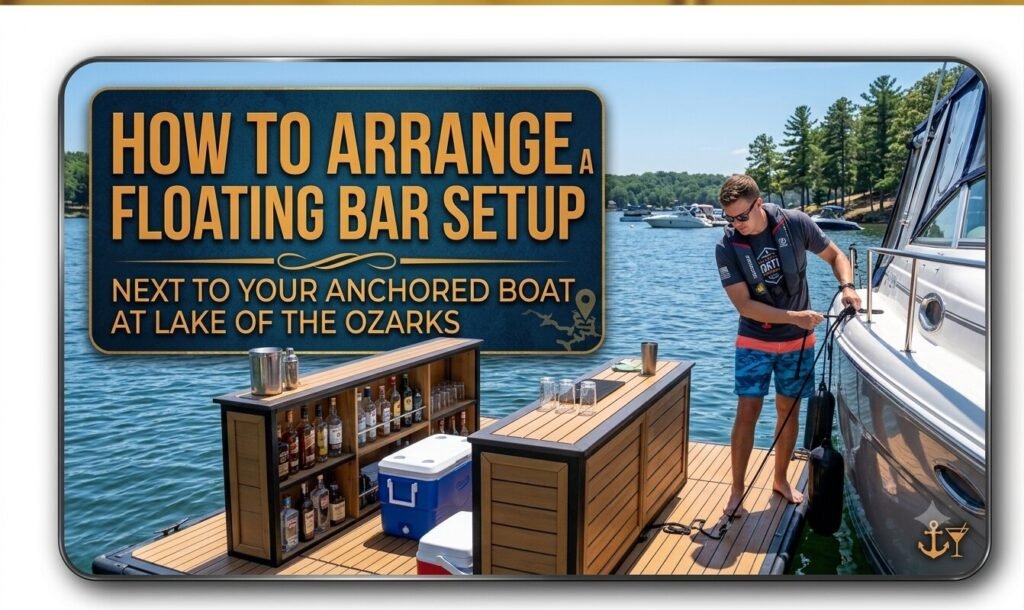
floating bar setup next to anchored boat Lake of the Ozarks
Guides

How to Arrange a Floating Bar Setup Next to Your Anchored Boat at Lake of the Ozarks

A floating bar changes everything about a swim stop. Your group is in the water. Drinks are floating right beside them. Nobody needs to climb back onto the boat. The party energy stays consistent. The swim stop that was supposed to last 45 minutes stretches naturally into two hours because nobody wants to leave. At Lake of the Ozarks, floating bar setups are a genuine tradition. At Party Cove near Mile Marker 26, they are practically expected. Groups that know LOTO arrive with a plan. They know what equipment to bring, how to secure it properly, and how to run it safely for the full swim stop window. This guide covers the entire process. What to buy. How to set it up. How to tether it correctly. What drinks work best. And the safety rules that keep the experience exactly what it should be. What a Floating Bar Is and Why It Works So Well at LOTO A floating bar is simply a drink station that floats on the water surface beside your anchored vessel. It can be as basic as a foam pool float holding a single cooler. It can be as fully featured as a purpose-built inflatable bar platform with built-in cup holders, a full-sized cooler, and enough room for six or seven people to stand in the water around it simultaneously. The concept works so well at Lake of the Ozarks for a simple reason. The lake experience is centered on being in the water. A floating bar keeps the social experience in the water with your guests rather than pulling them out of it every time they want a drink. It removes the constant interruption of climbing back onto the boat. It creates a central gathering point in the water where conversation flows naturally and the group stays together longer. At locations like Party Cove at Mile Marker 26, a well-set-up floating bar is what separates a memorable LOTO swim stop from an average one. Groups that arrive with a properly arranged floating bar become the social anchor for the entire area. Choosing the Right Equipment | Platform, Cooler and Accessories Getting the equipment right is the foundation of a successful floating bar setup at LOTO. The wrong platform creates instability. The wrong cooler allows ice to melt too quickly. Missing accessories mean guests are constantly improvising. The float platform is your most important purchase. The simplest option is a standard foam pool float or a flat inflatable swim platform. These are inexpensive and widely available. They work adequately for a small group with a single medium cooler. For groups of ten or more, they are simply not stable enough. They flex and rock under the weight of a full cooler plus leaning guests, and they are difficult to tether securely because they lack dedicated tie-off points. A purpose-built inflatable bar platform is the better choice for any serious LOTO floating bar setup. These are available from water sports brands including Intex, Airhead, and similar marine lifestyle suppliers. They come with built-in cup holders along the rails, molded handles at multiple tie-off points, stable flat surfaces designed to hold a cooler securely, and weight ratings typically between 300 and 600 pounds depending on size. A mid-range platform in the 400-pound weight rating range handles a full-sized cooler plus the leaning pressure of several guests without buckling or riding too low in the water. For a group of 12 to 20 people, a large-format platform keeps the cooler stable and gives everyone comfortable access from the water without crowding at one end. Your cooler choice matters more than most people expect. A hard-sided cooler with a secure latch or snap-down lid is the correct choice for a floating bar. Soft-sided coolers and open-top coolers perform poorly on a floating platform. Light chop from passing boats causes water to splash over the edge and into an open cooler, diluting the ice rapidly and warming your drinks faster. A 40 to 55 quart hard cooler with a positive-seal lid is the right capacity for most party groups at LOTO. It holds enough drinks for a full two to three hour swim stop without being too heavy to manage during setup. Always secure the cooler to the platform with a clip strap or a short bungee cord looped through the cooler handle and attached to a platform handle. This prevents the cooler from sliding off the platform if a guest grabs it unexpectedly from the water. For accessories, floating foam cup holders that clip onto the platform rail are essential. They keep canned and bottled drinks upright and accessible while guests stand in the water without needing to hold their drink constantly. Most purpose-built platforms include a set of built-in cup holders, but bringing extras is always a good idea for larger groups. Lidded plastic tumblers with sip openings work well for any mixed drinks or blended beverages that cannot go in a standard cup holder. A small floating snack tray tied to the platform with a short cord handles chips, fruit, and light snacks without requiring a separate float. Keep a compact trash bag secured to the vessel stern cleat to collect empties throughout the swim stop. This keeps the platform clean and prevents litter from entering the water, which is a legal requirement on Lake of the Ozarks under Missouri State Water Patrol environmental regulations. Setting Up, Tethering and Stocking the Floating Bar Setup sequence matters. Doing steps out of order wastes time and creates problems that are harder to fix once guests are in the water. Start by confirming the anchor position with the captain before you deploy anything into the water. The vessel must be fully stationary and the anchor must be holding before any equipment goes in the water. A vessel that shifts while the floating bar is deployed can jerk the tether lines and drag the platform into an unintended position or into swimmers nearby. Once the captain confirms the anchor is set,

Guides

Best Coves in Lake of the Ozarks for Clear Water Swimming and Snorkeling

Best Coves in Lake of the Ozarks for Clear Water Swimming and Snorkeling Most people never find them. The locals who know keep quiet about them. But the hidden coves of Lake of the Ozarks are some of the most breathtaking swimming spots in the entire Midwest, and once you experience one, you will never go back to the crowded main channel again. This is your complete guide to finding them. Lake of the Ozarks stretches over 1,150 miles of shoreline. It has more coastline than the entire state of California. Hidden within all of that shoreline are dozens of quiet, clear-water coves that most visitors completely miss. These are the spots where the water turns a deep, clean blue. Where you can see straight to the bottom. Where snorkeling feels like something you would do in the Caribbean, not the middle of Missouri. If you are renting a yacht or boat at Lake of the Ozarks, knowing where these coves are is the difference between a good day on the water and an unforgettable one. This guide covers the best coves for clear water swimming and snorkeling, how to find them, what to expect when you arrive, and everything you need to make the most of your time there. Why Lake of the Ozarks Has Such Surprisingly Clear Water Most people are shocked the first time they see the water quality in certain parts of Lake of the Ozarks. They expect a murky, muddy Midwest lake. What they find instead are sections of water with remarkable clarity and a rich blue-green color that looks almost tropical. The reason comes down to geography and water flow. Lake of the Ozarks is a reservoir fed by the Osage River. In the deeper, quieter coves that sit away from the main channel, there is far less boat traffic, less sediment disturbance, and better light penetration. These conditions combine to produce water that is noticeably clearer and more inviting than the busy main sections of the lake. The lake also has significant depth variations. In certain coves, the water drops quickly from a shallow, sandy shoreline into deeper, cooler sections below. This depth creates a layered, blue appearance from the surface that looks stunning in photographs and feels incredible to swim in. Water clarity at Lake of the Ozarks is best from late May through early July. During this window, algae growth is minimal, boat traffic has not yet reached its summer peak, and rainfall levels are typically lower. If you visit during these weeks and find the right coves, the swimming and snorkeling experience at Lake of the Ozarks genuinely rivals popular lake destinations that charge far more and require far more travel. The Best Coves for Clear Water Swimming at Lake of the Ozarks Grand Glaize Area Coves The Grand Glaize area sits near the 54-mile marker of the lake. This region consistently produces some of the clearest water conditions at Lake of the Ozarks throughout the summer season. The coves branching off from this stretch of the main channel are quieter than most. Boat traffic is lighter here compared to the more commercial sections of the lake near the 8-mile marker. Because of that reduced traffic, the sediment stays settled and the water remains noticeably cleaner. The shoreline in the Grand Glaize area is also less developed than other sections. More natural tree cover means less runoff into the water. This keeps the cove water cleaner throughout the season and gives the area a more remote, natural feel that is genuinely different from the resort-heavy stretches of the lake. For swimmers, the Grand Glaize coves offer a gradually deepening bottom that is perfect for wading in slowly before transitioning to open water swimming. For snorkelers, the rocky ledges in certain coves here host small populations of freshwater fish that are surprisingly interesting to observe up close. Ha Ha Tonka State Park Coves Ha Ha Tonka State Park sits on the western arm of Lake of the Ozarks. It is one of Missouri’s most unique natural areas and it sits directly on the water. The coves adjacent to the state park boundaries are among the most protected and least disturbed stretches of the entire lake. The water around Ha Ha Tonka has a distinctly different character from the main commercial sections of Lake of the Ozarks. It runs cooler. It runs cleaner. And in the right conditions, the underwater visibility here is exceptional. The geological character of this area also makes it fascinating for snorkelers. The Ozarks are limestone karst country. Underwater, that means rocky formations, ledges, and natural structures that create interesting terrain to explore. The combination of clear water and interesting bottom topography makes the coves near Ha Ha Tonka genuinely rewarding for anyone with a snorkel and a mask. Accessing these coves by boat is the ideal approach. You can anchor in the calm water just inside the cove entrance and swim freely without the current or boat traffic concerns that come with anchoring in the main channel. Gravois Arm Coves The Gravois Arm extends off the main body of Lake of the Ozarks and runs for several miles in a quieter direction away from the busiest resort areas. The coves along the Gravois Arm are consistently praised by local swimmers and boaters for their water clarity and peaceful atmosphere. This arm of the lake sees significantly less jet ski and high-speed boat traffic than areas closer to Osage Beach. That reduced disturbance keeps the water calmer and clearer throughout the day. Early mornings on the Gravois Arm feel almost completely serene. The water is glass-flat. The clarity is at its peak. And the coves are virtually empty. For snorkeling specifically, the Gravois Arm coves are ideal because the calmer water conditions make it much easier to see beneath the surface without waves and wakes constantly disrupting your visibility. The freshwater fish populations in this area are also more active and easier to observe than in busier

Guides

Professional Photography Tips for Posing on a Luxury Boat Swim Platform at Lake of the Ozarks

Everyone on that yacht looked amazing. You were there too. But your photos? They told a completely different story. That one frustrating truth is exactly why this guide exists. Posing on a luxury boat swim platform sounds simple. But there is a reason some people walk away with breathtaking photos every single time, while others get nothing but awkward angles and wasted shots. The difference is not the camera. It is not even the location. It is knowing exactly what to do the moment you step onto that platform. Lake of the Ozarks is one of the most photogenic spots in the entire Midwest. The deep blue water, the sprawling shoreline, and the luxury yachts make for an absolutely stunning backdrop. But a great backdrop alone does not make a great photo. Pose wrong, use bad lighting, or stand at the wrong angle, and even the most beautiful setting in the world will not save the shot. This guide fixes all of that. You are going to learn exactly how to pose, where to stand, when to shoot, and what to wear. Every tip here is practical. Every tip is proven. And by the time you finish reading, you will step onto that swim platform with total confidence and walk away with photos that genuinely look professional. Why the Swim Platform Is the Best Spot on Any Luxury Yacht Most people spend their entire yacht charter taking photos from the main deck. They never even think about the swim platform. That is one of the biggest photography mistakes you can make on a luxury boat. The swim platform sits right at water level. That single fact changes everything about how your photos look. When you shoot from the main deck, you get boat rails, life jackets, and equipment cluttering your background. When you shoot from the swim platform, you get open water, open sky, and nothing else. The result is a clean, cinematic composition that instantly looks more professional. At Lake of the Ozarks, this matters even more. The lake itself is the star of the show. The swim platform puts you right in the middle of it. You are not looking down at the water from a railing. You are standing above it, surrounded by it, and the camera captures all of that natural beauty around you. There is also the reflection factor. At water level, the surface of the lake acts like a mirror. When the light hits it right, your photos gain a depth and dimension that you simply cannot get from higher up on the boat. Photographers spend years chasing that kind of natural light. On a swim platform at Lake of the Ozarks, it is available to you every single time you step out there. The Golden Hour Rule That Changes Every Photo Ask any professional photographer when to shoot outdoors and they will give you the same answer every time. Golden hour. Without exception. Golden hour happens twice a day. Once just after sunrise. Once just before sunset. During these windows, the sun sits low on the horizon. The light becomes warm, soft, and directional. It wraps around your face and body in a way that midday light simply cannot replicate. Shadows become gentle. Skin tones look richer. The water behind you glows. At Lake of the Ozarks, golden hour is extraordinary. The way the late afternoon sun reflects across the water creates a natural warmth that makes every photo look like it was taken on a professional set. If you have the option to schedule your yacht charter around this window, do it. It will be the single best photography decision you make. Midday light, on the other hand, is your enemy. When the sun is directly overhead, it creates harsh shadows under your eyes, nose, and chin. It washes out colors. It makes the water look flat. If you are stuck shooting during midday, position yourself in open shade or use the natural shadow of the yacht’s canopy to soften the light. Overcast days are actually a hidden blessing. Cloud cover acts as a giant natural diffuser. It spreads light evenly across the entire scene and eliminates harsh shadows completely. Many professional photographers actually prefer shooting on lightly overcast days for portraits. If your charter day is cloudy, do not be discouraged. Your photos may actually turn out better than a sunny afternoon session. How to Stand on a Swim Platform Like You Own It The biggest mistake people make on a swim platform is standing perfectly straight and stiff. It looks unnatural in photos. It looks uncomfortable. And it immediately kills the luxurious, relaxed energy that a yacht charter is supposed to convey. Confidence in photos comes from body language. And body language on a boat has its own specific rules. Start with your weight. Never stand with your weight evenly distributed on both feet. Shift your weight onto one hip. This creates a natural curve in your body and makes your posture look relaxed and effortless. Combined with the open water behind you, this single adjustment transforms the energy of a photo completely. Turn your body at a slight angle to the camera. Standing directly face-on to the lens makes you look wider and flatter. When you angle your body between 30 and 45 degrees, you create a natural slimming effect and add dimension to the shot. Your shoulders should be turned slightly away from the camera while your face turns back toward it. This is the pose that models and influencers use constantly, and it works just as well on a boat as it does on a runway. Your arms are one of the most common problem areas in boat photography. When your arms hang straight at your sides, they press against your body and look awkward. Instead, create space. Rest one hand on your hip. Let the other hand hang loosely at your side with a slight bend at the elbow. If you are wearing a cover-up

Guides

How to Set Up an Onboard Grill Without Damaging the Yacht Deck at Lake Ozark

Nothing beats a freshly grilled meal on the water. But one wrong move with an onboard grill can permanently damage a yacht deck worth thousands of dollars. Lake Ozark is one of Missouri’s finest boating destinations. Spending a full day on a luxury charter yacht here is an experience most people remember for years. And for many groups, that experience is not complete without food fresh off the grill. The smell of grilling meat drifting across calm lake water. Cold drinks in hand. Beautiful scenery in every direction. It sounds perfect because it is. The challenge is doing it correctly. Yacht decks are expensive surfaces. They are made from materials that react badly to direct heat, grease, and open flame in the wrong conditions. A grill setup that works perfectly at a backyard cookout can cause serious damage on a boat deck without the right precautions. This guide covers every step of setting up an onboard grill safely and correctly on your Lake Ozark yacht charter. From choosing the right grill to protecting the deck surface to cooking safely on open water. Follow these steps and you get the meal and the memories without the damage. Why Grilling on a Lake Ozark Yacht Charter Is Worth Doing Right Food changes everything about a day on the water. A lunch break in a quiet Lake Ozark cove with freshly grilled food is one of those simple experiences that elevates an already great day into something genuinely special. It adds warmth, comfort, and a communal element that packaged food simply cannot match. Grilling on a yacht also gives your group independence. You choose what you eat. You cook it fresh. You eat it exactly when you want. No rushing back to the marina for lunch. No settling for whatever the cooler has left. For families, the grilling experience itself becomes part of the day. Adults enjoy the cooking process. Kids love the novelty of a hot meal on a boat. It creates natural gathering time between swimming sessions and water activities. For adult groups and corporate charters, a well-executed onboard grill setup signals preparation and intention. It transforms a basic boat day into a curated experience that guests genuinely appreciate. The key is that none of this happens by accident. It requires the right equipment, the right setup process, and the right precautions for the yacht deck. This guide provides all three. Understanding Yacht Deck Materials and Their Vulnerabilities Before choosing a grill or setting anything up, understand what you are working with. Yacht decks are built from a range of materials depending on the vessel type and age. Each material has specific vulnerabilities to heat, grease, and open flame. Fiberglass is the most common deck material on recreational and charter yachts. It is durable and weather resistant. But it has limited heat tolerance. Direct contact with a hot grill surface causes fiberglass to discolor, blister, or warp permanently. Even residual heat from a grill that has been turned off can damage fiberglass if contact is maintained. Teak wood decking is found on premium and luxury charter vessels. It is beautiful and naturally weather resistant. But it is highly vulnerable to grease staining. Grease penetrates teak grain deeply and is extremely difficult to remove. Heat can also char teak surface layers. Teak damage is costly to repair and sometimes impossible to fully restore. Composite decking materials are increasingly common on newer charter vessels. They are designed to resist weathering but vary significantly in their heat tolerance depending on composition. Some composites perform well under indirect heat. Others discolor easily with any sustained heat exposure. Vinyl or rubber non-slip surfaces cover many deck areas on charter vessels. These materials are particularly vulnerable to heat. Direct grill contact melts and deforms vinyl surfaces quickly. Even reflected heat from a nearby grill body causes vinyl non-slip textures to flatten and degrade. Knowing your deck material helps you choose the right protective measures. If you are unsure what material the charter vessel’s deck is made from, ask the captain before setting up any cooking equipment. Choosing the Right Grill for Onboard Use Not every grill is appropriate for use on a yacht. The right grill for onboard use is compact, stable, controllable, and designed with marine safety in mind. Marine-specific grills are the best choice. Companies like Magma Products manufacture grills specifically engineered for boat use. These grills mount securely to boat rails. They use propane fuel for clean and controllable heat. They have integrated grease management systems that prevent drips onto deck surfaces. They are built from marine-grade stainless steel that resists corrosion from constant water exposure. A Magma Marine Kettle or a comparable marine rail-mount grill is the ideal setup for a Lake Ozark yacht charter. It attaches to the stern rail or side rail of the vessel. It holds its position securely even in light chop. The cooking surface sits completely over the water or at minimum over the rail edge rather than over the deck surface. This eliminates the primary risk of deck heat damage. Portable propane grills are the second option. Small tabletop propane grills like the Weber Q series or Coleman Road Trip models are practical for boat use. They are compact and easy to transport. They heat quickly and cool quickly. They require proper deck protection underneath them but are manageable with the right setup. Avoid charcoal grills entirely on a yacht charter. Charcoal produces uncontrolled embers. Wind on open water carries lit embers unpredictably across the deck surface. A single ember landing on teak decking or a vinyl surface causes immediate damage. Ash management on a moving or rocking vessel is impractical. Charcoal grills also take significantly longer to reach cooking temperature and to cool down safely. The risk to reward ratio on a charter vessel makes charcoal grills a poor choice regardless of how good the food tastes. Avoid open flame camp-style stoves. These are not designed for marine environments. They tip in any vessel movement.

Guides

Safety Guidelines for Using a Water Slide on a Double Decker Boat at Lake Ozark

A water slide on a double decker boat sounds like pure fun. And it is. But only when everyone knows the safety rules before anyone climbs up. Lake Ozark is home to some of the most exciting charter vessels in Missouri. Among the most popular are double decker boats equipped with built-in or inflatable water slides. These boats draw families, groups, and party charters from across the Midwest every summer. The combination of a two-level vessel with a slide dropping directly into the lake creates an experience that genuinely cannot be matched anywhere else on inland water. But height changes everything about water safety. A slide on a double decker boat launches riders from an elevated position into open lake water. The speed, the entry angle, and the depth of entry are all significantly greater than a standard pool slide. Without proper guidelines, what should be the highlight of the day can quickly become a serious situation. This guide covers every safety guideline you need. From pre-launch checks to rules for every age group to what to do when something goes wrong. Read it before your trip. Share it with your group. And enjoy every single slide with complete confidence. Why Double Decker Boats at Lake Ozark Are Unique Double decker boats are not standard charter vessels. They are purpose-built for maximum fun on the water. The lower deck operates like a standard pontoon or party boat. Seating, shade, a swim platform, and easy water access define this level. The upper deck sits 8 to 12 feet above the water surface. It provides panoramic views of Lake Ozark. It creates space for sunbathing and lounging away from the activity below. The water slide connects the upper deck to the lake. Riders climb to the upper level, position themselves at the top of the slide, and descend directly into the water below. The drop height combined with the slide angle creates entry speeds that are considerably faster than anything riders experience in a typical pool setting. This is exactly what makes these boats so thrilling. It is also exactly what makes safety guidelines so important. Lake Ozark has ideal conditions for double decker boat charters. The coves provide calm, deep water for safe slide entry. The open sections provide cruising opportunity between activity stops. And the lake’s size means charter operators can find quiet spots away from congested traffic even during peak summer weekends. Understanding the Risks of Water Slides on Elevated Boats Before the rules make complete sense, understanding the risks helps. Height creates speed. A slide entry from 10 feet above the water surface produces significantly more impact on entry than a slide at ground level. The body hits the water at greater force. Incorrect entry positions cause injury. Belly flops from height are genuinely painful and can cause winding or bruising. Head-first entries from elevated slides carry serious spinal injury risk. Water depth is critical. Lake floors vary. Coves that look deep can have shallow sections near the edges. A rider entering feet first at high speed in water that is too shallow impacts the bottom with serious force. Depth verification before slide use is not optional. It is essential. Swimmer traffic creates collision risk. When multiple people are in the water below the slide, a descending rider can land on a swimmer. This causes injury to both parties. Maintaining a clear landing zone is a fundamental rule for any boat water slide. Weather and vessel movement compound risks. A rocking boat changes the slide angle unexpectedly. Wind affects a rider’s trajectory off the slide. Rain makes surfaces slippery. These factors require constant monitoring and willingness to stop slide activity when conditions change. Knowing these risks is what makes the safety guidelines meaningful. Each rule directly addresses one of these specific dangers. Rule One: Verify Water Depth Before Every Slide Session This is the first rule. It is non-negotiable. Before anyone uses the water slide, the depth directly below and within 15 feet of the slide exit must be verified. Lake Ozark coves are generally deep. But anchoring positions vary. The slide exit point may sit over water that is shallower than the main cove body. Even a small variation in anchoring position can change depth conditions significantly. Use the vessel’s depth finder to check the reading directly below the slide exit zone. A minimum depth of 8 feet is required for slide use. For larger adults or high-speed entry situations, 10 feet of depth is a safer minimum. If the depth finder is unavailable or the reading is unclear, use a weighted line to physically measure depth at the entry point. Do not estimate. Do not assume. Measure directly. If depth is insufficient, reposition the vessel. Move to deeper water before allowing any slide activity. This step takes five minutes. The injury it prevents can be permanent. Rule Two: Establish and Enforce a Clear Landing Zone The landing zone is the area of water directly below and around the slide exit. This zone must be completely clear of people before any rider descends. Designate a landing zone watcher for every slide session. This person stands or sits at a position where they can see both the top of the slide and the water below simultaneously. Their only job is managing the landing zone. They do not swim. They do not use their phone. They watch. Before any rider descends, the zone watcher confirms the water is clear. They give a verbal or hand signal clearance to the rider at the top. The rider does not slide until they receive that clearance signal. After a rider enters the water, they must exit the landing zone immediately. They swim to the swim ladder or to the side of the vessel. They do not linger in the landing zone. The next rider does not descend until the previous rider is completely clear of the zone and has signaled they are safe. This sequence applies every single time. Without exception.

Guides

How to Capture the Best Drone Video of Your Moving Charter Yacht at Lake Ozark

One great drone shot of your yacht on Lake Ozark is worth a thousand regular photos. And capturing it is easier than most people think. Lake Ozark is one of Missouri’s most visually stunning destinations. The water changes color throughout the day. The coves create dramatic natural framing. The shoreline stretches endlessly in every direction. When you add a luxury charter yacht moving through that scenery, you have the ingredients for genuinely cinematic footage that looks like it belongs in a travel documentary. Drone video captures all of this in a way that nothing else can. It shows scale. It shows speed. It shows the relationship between the vessel and the water around it. The perspective from above transforms a great day on the water into something that looks breathtaking on any screen. But getting great drone footage of a moving yacht is a skill. It requires planning. It requires understanding the right shots. It requires knowing the rules. And it requires a little technical knowledge about how to get your drone and your camera settings working together correctly. This guide covers every part of that process. From legal requirements to shot selection to editing tips that turn raw footage into something you will want to share with everyone. Why Lake Ozark Is a Perfect Setting for Yacht Drone Footage Location matters enormously in drone videography. Great footage needs great backgrounds. Lake Ozark delivers them naturally. The lake has long stretches of open water that allow a moving yacht to build real speed. Speed creates wake. Wake creates visual drama. A yacht cutting through open water at speed with a white wake trailing behind it is one of the most visually compelling shots in boating photography. The coves provide contrast. When a yacht moves from open water into a sheltered cove, the surrounding trees and cliffs create tight, dramatic framing from above. The scale of the vessel against the natural landscape becomes immediately apparent from an aerial perspective. Light changes throughout the day at Lake Ozark in ways that continually create new opportunities. Morning light creates long shadows and warm golden tones on the water surface. Midday light gives vivid color saturation. Late afternoon produces the golden hour effect that every filmmaker chases. Each period of the day gives your footage a completely different character. Water clarity also matters for drone footage. Lake Ozark water in summer is clear enough that the depth and color variation underwater is visible from altitude in certain areas. This adds visual depth and richness to footage shot over shallow coves or clear channel sections. All of these elements combine to make Lake Ozark one of the finest settings for drone yacht videography in the entire Midwest. FAA Rules and Missouri Regulations You Must Know First Before your drone leaves the ground, you need to understand the rules. The Federal Aviation Administration governs all drone operations in the United States. Missouri has no separate state-level drone regulations that supersede FAA rules. FAA regulations apply fully at Lake Ozark. The FAA requires all drones weighing more than 0.55 pounds to be registered. Most consumer drones including DJI models weigh significantly more than this threshold. Registration is done online through the FAA DroneZone website. It costs five dollars and takes minutes. Display your registration number on the exterior of your drone before every flight. Recreational drone operators must pass the FAA TRUST test. TRUST stands for The Recreational UAS Safety Test. It is a free online test available through FAA approved organizations. Completion takes about 30 minutes. You must carry proof of completion when flying. If you intend to fly commercially or for any compensation, you need a Part 107 Remote Pilot Certificate. This requires passing a more comprehensive FAA knowledge test at a testing center. For personal vacation footage from a yacht charter, recreational rules apply. For any professional or commercial use, Part 107 certification is required. Key operational rules include flying below 400 feet above ground level. Flying within visual line of sight at all times. Never flying over people who are not directly involved in your operation. Never flying near other aircraft. Yielding right of way to all manned aircraft at all times. Lake Ozark does not sit within any controlled airspace that requires advance authorization for recreational flights. However, check the FAA B4UFLY app before every flight. Airspace can change temporarily due to TFRs. Temporary Flight Restrictions are issued for emergencies, special events, and other situations. Flying in a TFR without authorization carries serious legal consequences. Choosing the Right Drone for Yacht Videography The drone you use determines the quality of your footage. For moving yacht videography, three capabilities matter most. Camera quality. Flight stability in wind. And obstacle avoidance. The DJI Mini 4 Pro is an excellent choice for recreational users. It weighs under 249 grams. This keeps it below the FAA registration threshold for recreational flyers in many contexts though registration is still advisable. It shoots 4K video at 60 frames per second. It has excellent wind resistance for its size. And it folds to an extremely compact form that travels easily on a yacht charter. The DJI Air 3 is a step up in both camera quality and wind performance. It has a dual camera system with both a main wide angle lens and a medium telephoto lens. The telephoto lens is particularly useful for yacht videography. It allows you to maintain safe distance from the vessel while still capturing tight detail shots. The DJI Mavic 3 Classic is the professional option for serious videographers. It uses a Hasselblad camera sensor. It shoots 5.1K video. Wind resistance is exceptional. Battery life is longer than smaller models. If you want the absolute best image quality for Lake Ozark yacht footage, this is the drone to use. Regardless of which drone you choose, bring multiple batteries. A single battery gives you 20 to 30 minutes of flight time. Moving yacht footage requires multiple passes from different angles. You will want at

Guides

Stand Up Paddleboarding From a Stationary Yacht in Quiet Coves at Lake Ozark

Some moments on the water stay with you forever. Standing on a paddleboard in a quiet Lake Ozark cove with nothing but still water around you is one of them. Lake Ozark stretches across more than 54,000 acres of Missouri water. It has over 1,150 miles of shoreline. Tucked along that shoreline are dozens of quiet, sheltered coves. They are calm. They are beautiful. And they are absolutely perfect for stand up paddleboarding. When you combine a luxury yacht charter with a paddleboard launched directly from the stern, you get an experience that is hard to match anywhere in the Midwest. The yacht becomes your floating base camp. You anchor in a cove. You launch the board from the swim platform. And then you explore the water on your own terms. At your own pace. In complete peace. This guide covers everything about stand up paddleboarding from a stationary yacht at Lake Ozark. Equipment selection. Beginner technique. Safety requirements. Cove exploration tips. And how to make the most of this experience on your next charter. Why Quiet Coves at Lake Ozark Are Perfect for SUP Stand up paddleboarding requires calm water. Open water with chop, wakes, and wind makes SUP significantly harder. Beginners struggle. Even experienced paddlers work much harder than they need to on rough surfaces. The quiet coves of Lake Ozark solve this problem naturally. Coves are sheltered from main channel boat traffic. The water inside them is consistently calmer than the open lake. Wind has less fetch in a sheltered cove so surface chop is minimal. For paddleboarding, this translates to easier balancing, smoother gliding, and a far more enjoyable experience. Lake Ozark has an enormous number of these coves. Some are tucked behind headlands. Some extend deep into the shoreline. Many have no residential docks nearby. They feel completely private even in the peak of summer. When you anchor your charter yacht in one of these coves and launch a paddleboard, you are effectively in your own private water park. No boat traffic. No noise. Just water, trees, and sky. This is why SUP from a Lake Ozark yacht charter is one of the most sought after water activities on the lake. It combines the luxury of a private vessel with the freedom and mindfulness of paddleboarding in genuinely beautiful surroundings. What Is Stand Up Paddleboarding Stand up paddleboarding is exactly what it sounds like. You stand on a wide, buoyant board. You use a long single-bladed paddle to propel yourself across the water. Your core keeps you balanced. Your arms and shoulders drive the paddle. Your legs absorb small variations in the water surface. It looks simple. For most people, it feels simple within the first 20 minutes. Balance comes quickly on calm water. Paddling technique takes a little longer to refine but the basics are accessible to almost anyone regardless of fitness level or prior water sports experience. SUP is a full body workout. It engages the core, shoulders, back, and legs simultaneously. But it does not feel like exercise while you are doing it. It feels like exploration. This is part of what makes it so popular. At Lake Ozark, SUP is popular across all age groups. Teenagers love the freedom. Adults love the meditative quality of moving quietly across still water. Even older adults find it manageable and deeply enjoyable on the calm cove surfaces the lake provides. Types of Paddleboards Suited for Lake Ozark Cove Use Choosing the right board makes a big difference. There are two main categories. Hard boards and inflatable boards. Hard boards are made from fiberglass, carbon fiber, or epoxy. They are stiffer. They glide more efficiently through the water. Experienced paddlers often prefer them for performance. But hard boards are impractical for yacht charter use. They are long and rigid. Storing them on a vessel is difficult. Transporting them requires a roof rack or trailer. For most Lake Ozark charter situations, hard boards are simply not the right choice. Inflatable SUP boards are the practical solution for yacht charter use. When deflated, an inflatable SUP packs into a bag roughly the size of a large backpack. It weighs between 15 and 25 pounds. It stores easily in yacht storage compartments, below deck, or in bow storage areas. When inflated with an electric pump, it becomes rigid and stable enough for confident open water use. For Lake Ozark cove paddleboarding from a yacht, choose inflatable boards with the following characteristics. Width of at least 32 inches. Wider boards are more stable. Beginners benefit enormously from extra width in those first minutes of finding their balance. Length between 10 and 11 feet. This length suits most adult paddlers well. It tracks straight without being difficult to maneuver. Thickness of at least 6 inches. Thicker boards provide more buoyancy and rigidity when inflated. They feel more like a hard board under your feet and less like a soft mat. Maximum pressure rating of 15 PSI or higher. Higher maximum pressure means the board can be inflated to greater firmness. A firmer board performs better and feels more stable. Deck pad covering at least the rear two thirds of the board. The deck pad is the textured foam surface you stand on. More coverage means more foot placement options. It also provides cushioning for kneeling or sitting. Multiple D-rings on the deck surface. These allow you to strap gear to the board. On a Lake Ozark day trip, attaching a small dry bag with water and sunscreen is practical and convenient. Essential Equipment for SUP From a Yacht The board is just the beginning. Several other pieces of equipment are essential for a safe and enjoyable session on Lake Ozark. The paddle is as important as the board itself. Use an adjustable paddle so that multiple people of different heights can use it comfortably. The correct paddle height is roughly 6 to 10 inches above your head when standing. Too short and you hunch uncomfortably. Too long and your

Guides

Best Water Toys to Keep Kids Entertained During a Private Boat Cruise at Lake Ozark

Kids on a boat get bored faster than you think. The right water toys change everything about your family day on Lake Ozark. Lake Ozark is one of Missouri’s finest destinations for families. The water is clean. The coves are calm and safe. And a private yacht rental gives your family exclusive access to one of the most beautiful lakes in the Midwest. Parents love the peace and the scenery. But kids need more than a pretty view to stay happy for a full day on the water. That is exactly where water toys come in. The right selection keeps children engaged for hours. It turns a cruise into an adventure. It makes the yacht feel like a floating playground. And it creates the kind of memories that families talk about for years. This guide covers the best water toys for kids on a private boat cruise at Lake Ozark. Every option is chosen for safety, fun, and practicality on open lake water. Whether your kids are toddlers or teenagers, there is something here that will make their day unforgettable. Why Water Toys Matter on a Lake Ozark Yacht Charter A yacht charter without water toys is just a boat ride. Kids experience time differently than adults. An hour of cruising feels like five minutes to a parent. It feels like forever to a seven year old. Water toys solve this problem completely. They give kids something active to do. They burn energy. They create excitement at every anchoring stop. They make children excited about the trip from the moment you start packing. For parents, water toys provide something equally valuable. Peace of mind. When kids are happily playing with a float, a tow tube, or a water blaster, parents can actually relax. They can enjoy a drink. They can take in the Lake Ozark scenery. They can have a conversation without constant interruption. The right toys also improve safety. Structured water activities keep kids in designated areas near the boat. Unoccupied kids wander. Active kids stay where the fun is. Every family booking a Lake Ozark yacht rental with children should think carefully about what toys to bring. This guide makes that decision easy. Safety First: What Every Family Needs Before the Toys Come Out Before any toy enters the water, safety equipment must be in place. Every child on the water needs a properly fitted Coast Guard approved life jacket. This is Missouri law. It is also common sense. A life jacket that fits correctly does not restrict movement. Kids can swim, play, and use water toys comfortably while wearing one. Check fit before the trip. The jacket should be snug but not tight. When you lift the jacket by the shoulders, the child’s chin and ears should not slip through. Replace any jacket that no longer fits properly. Designate a water spotter for every session when kids are in the water. This person watches only the children. They do not look at their phone. They do not chat. Their entire focus is the kids in the water. Rotate this responsibility among adults throughout the day. Establish clear water boundaries before kids enter the water. Show them where they can swim and where they cannot go. Repeat these boundaries at every new anchoring spot. With safety covered, the fun can begin. Best Water Toys for Young Children Ages 3 to 7 Young children need toys that are safe, buoyant, and easy to use. They do not need speed or complexity. They need something colorful, fun, and completely manageable in the water alongside a supervising adult. Inflatable Animal Ride-On Floats These are the classics for a reason. Oversized inflatable animals like unicorns, flamingos, sharks, and dinosaurs are endlessly entertaining for young children. They are large enough to sit on comfortably. They are stable in calm cove water. They float effortlessly. At Lake Ozark, the calm coves are perfect for ride-on floats. The water is still. There is no current to deal with. A child can sit on their flamingo float for an hour without getting tired of it. Choose ride-on floats made from heavy duty vinyl rated for open water use. Standard pool inflatables are too thin for lake conditions. Look for reinforced seams and integrated handles that children can grip securely. Always tether ride-on floats to the yacht with a short line. Young children cannot control where they drift. A tether keeps them within arm’s reach of supervising adults at all times. Foam Water Noodles Simple. Lightweight. Endlessly versatile. Foam noodles are one of the best investments for a family boat day. They cost very little. They take almost no storage space. And kids aged 3 to 10 find dozens of ways to play with them. Kids use noodles as floatation aids. They use them as pretend swords. They build rafts with them. They balance on them. They throw them and retrieve them. The creativity kids apply to a simple foam noodle is remarkable. Bring at least four to six noodles for a group of children. They are so light that storage is never an issue. Pack them in a large mesh bag and they weigh almost nothing. Water Blasters and Squirt Toys Water play is always a hit with young children. Large water blasters that kids pump and shoot are perfect for boat days. They are safe. They are simple to operate. And a water fight on a hot Lake Ozark afternoon is the definition of summer fun. Choose water blasters made from durable plastic with simple pump mechanisms. Young children can operate these without adult help. This independence matters. It keeps them entertained without needing constant adult engagement. Bring extras. Water blasters get lost overboard. Having spare units means the fun continues even when one disappears into the lake. Floating Ring Toss and Ball Games Organized water games give young children structure. Floating ring toss sets anchor to the water near the boat. Children throw rings from the swim platform or from the water. It

Guides

How to Pack and Secure Oversized Swim Saddles for a Boat Day at Lake Ozark

Most people show up to their boat day completely unprepared for one thing. Their oversized swim saddles take over the entire deck before they even leave the dock. Lake Ozark is one of Missouri’s most stunning water destinations. The coves are calm. The water is clear. And a luxury yacht rental here gives you the perfect platform for a full day of swimming, floating, and relaxing on the water. Oversized swim saddles are one of the most popular water toys for exactly this kind of day. They are comfortable. They are fun. And they look incredible floating in a quiet cove. The problem is getting them there safely and in good condition. Large inflatables are awkward to transport. They take up enormous space. They catch wind on an open boat. And if they are not secured properly, they become a hazard before you even reach your anchoring spot. This guide covers everything. How to pack swim saddles correctly. How to store them on a yacht. How to secure them during transit. And how to get the most out of them once you arrive at Lake Ozark. What Are Oversized Swim Saddles Swim saddles are inflatable water toys designed for sitting or straddling on open water. They look like large floating seats. Most have a wide body with a raised center section that riders sit on. Legs hang down into the water on both sides. Arms rest on the sides or float naturally. Oversized versions are larger than standard pool floats. They typically measure 5 to 7 feet in length. Some are even wider. They are built for open water use. They have thicker vinyl construction. They handle light chop and boat wake better than basic pool inflatables. At Lake Ozark, swim saddles are extremely popular on yacht charters. Guests anchor in a quiet cove and drift on them. They use them for sunbathing. Kids ride them like horses in the water. Adults relax on them for hours. The challenge is always the same. Getting them from home to the dock to the water without damage and without chaos. Why Packing and Securing Matters on a Yacht Charter A yacht is not a minivan. Space on a charter vessel is organized and intentional. Everything has a place. Guests need room to move safely. The captain needs clear sightlines. The deck needs to stay clear for safety reasons. An unsecured oversized swim saddle on a moving boat is a real problem. It catches wind like a sail. It slides across the deck during turns. It can go overboard at speed. It blocks pathways and creates trip hazards. Vinyl inflatables also damage easily. Contact with sharp edges, rough surfaces, or excessive heat causes punctures and tears. A swim saddle that arrives at the cove with a slow leak is useless. Packing correctly prevents this. Good packing also saves time. When you arrive at your anchoring spot on Lake Ozark, you want to be in the water quickly. Not searching through a pile of deflated vinyl trying to figure out what goes where. Step One: Choosing the Right Swim Saddles for a Boat Day Before you even think about packing, choose the right saddles for your trip. Not all swim saddles are designed for open water use. Standard pool floats are made from thin vinyl. They puncture easily. They lose shape in light chop. They are not built for the conditions at Lake Ozark where passing boat wakes create regular surface movement. Choose saddles specifically labeled for lake or open water use. These have reinforced seams. The vinyl is thicker. Handles are built into the design for carrying and tethering. They hold their shape better and last longer in real water conditions. Check the inflation valves. Quality open water saddles use Boston valves or spring valves. These close automatically when the inflation nozzle is removed. Air does not escape. Inflation is faster and deflation is fully controllable. Buy saddles with tether loops or attachment points. These are small rings or loops built into the float body. They allow you to tie the saddle to the yacht or to a buddy line in the water. Without them, saddles drift away the moment you let go. Consider size relative to your group. One oversized saddle per two adults is a good ratio for a comfortable day. Too many large floats creates storage and management problems on any size vessel. Step Two: Deflating Swim Saddles Correctly Before the Trip The most common mistake is bringing fully inflated saddles onto a yacht. A fully inflated oversized swim saddle is enormous. It takes up the space of a small person. On a boat with multiple guests and equipment, this is simply not practical. Deflate saddles completely before bringing them to the dock. Open the valve fully. Press the float body flat starting from the end opposite the valve. Work the air toward the valve opening systematically. Push firmly and evenly. This removes as much air as possible. Fold the saddle while it is still flat. Do not roll it randomly. Fold it in thirds lengthwise first. Then fold it in half or thirds again depending on its length. This creates a compact flat package that is easy to store and carry. Close the valve tightly once deflation is complete. Even a small amount of residual air is fine. The goal is maximum compaction not perfect emptiness. A fully deflated oversized swim saddle folds down to roughly the size of a large beach towel. Sometimes smaller. This is what you bring to the dock. Step Three: Packing Swim Saddles for Transport to the Dock How you pack the saddles before the boat matters. Use a large mesh bag or a dedicated inflatable storage bag for each saddle. Mesh bags allow any residual moisture to evaporate. They prevent mildew and odor developing during storage or transport. They also keep the saddle protected from sharp objects during carrying. If you are using a standard duffle or tote bag, line it with

Scroll to Top