
Pulling up to a lakefront restaurant by boat is one of the best experiences Lake of the Ozarks has to offer. You cruise up to the dock, tie off, step ashore, and walk straight into lunch or dinner with a great view of the water behind you. It feels effortless when it is done right.
But docking a twin engine yacht at a busy lakefront restaurant takes real skill. The docks are often crowded. Other boats are coming and going constantly. Wind and current can push your vessel off your intended line at any moment. One small mistake in a tight dock can mean a scrape, a collision, or an embarrassing moment in front of a full restaurant crowd.
This guide covers everything you need to know about docking a twin engine yacht at a lakefront restaurant at Lake of the Ozarks. Whether you are new to twin engine handling or just want to sharpen your skills before a big lake trip, this is your complete practical guide.
Understanding Your Twin Engine Advantage
A twin engine yacht gives you a docking advantage that a single engine vessel simply does not have. Two engines mean two independent thrust points. You can push the bow left while the stern goes right. You can spin the boat almost in place. You can hold your position against wind or current without using the helm at all.
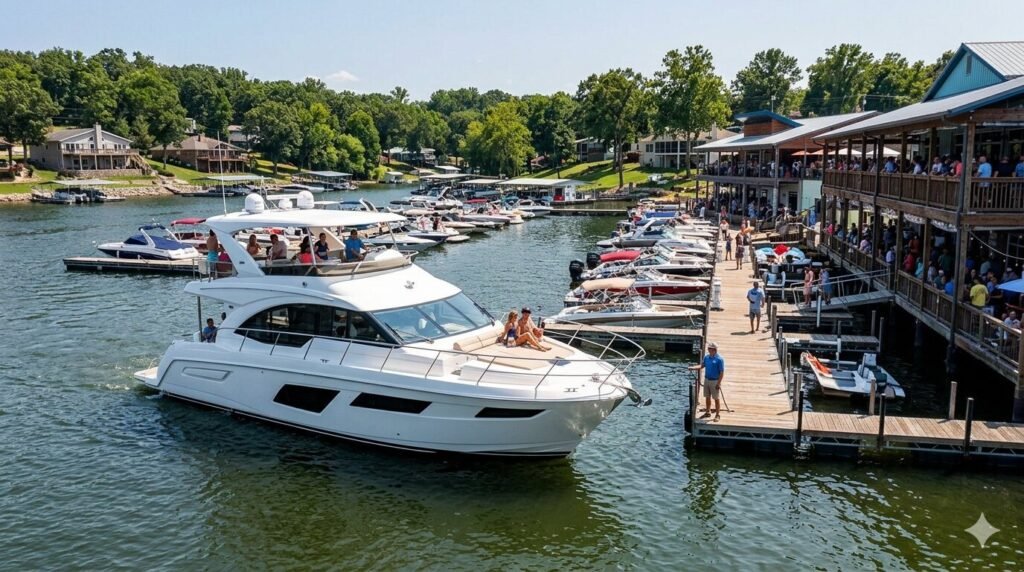
This level of control is what makes twin engine yachts so well suited for tight dock situations. Lakefront restaurants at Lake of the Ozarks often have busy, compact docking areas. Boats are packed in closely on summer weekends. The ability to maneuver precisely in small spaces is not just a convenience. It is a genuine safety advantage.
The key to using twin engines effectively is understanding how they interact. Running both engines forward moves the boat straight ahead. Running one forward and one in reverse spins the boat around its center point. This is called a pivot turn. It is the foundation of almost every tight docking maneuver a twin engine yacht will ever perform. Practicing this movement in open water before you approach a crowded dock is always the right preparation.
Understanding your yacht’s prop walk is also important. Each propeller pulls the stern slightly to one side when in reverse. On a twin engine setup, these forces can work together or against each other depending on your engine inputs. Knowing how your specific vessel responds to reverse thrust from each engine separately gives you much better predictive control during the final moments of any dock approach.
Reading the Dock Before You Approach
Never rush a dock approach at a lakefront restaurant. Always take a full pass by the dock before you commit to docking. This is called a reconnaissance pass and experienced captains do it every single time. It gives you critical information that you cannot get from a distance.
During your pass, look at the available space. Identify exactly where you plan to land. Note which direction the wind is blowing and how it will affect your vessel during the approach. Check for any obstacles like floating debris, shallow areas near the dock edge, or mooring lines from other boats that extend into your intended path. Look at how other boats are positioned and whether any are preparing to leave.
Wind direction is the single most important environmental factor in any dock approach. At Lake of the Ozarks, afternoon winds typically build from the south or southwest during summer months. Wind pushes your hull sideways as you slow down. A slower boat reacts more strongly to wind because engine thrust is reduced. Understanding how the wind will move your yacht during those final slow moments before contact is essential planning.
Current matters less at Lake of the Ozarks than at tidal waterways, but it does exist near certain areas and during high water periods. Check for any visible current movement near the dock pilings before you approach. Even a mild current against your bow or beam changes the docking calculation. Knowing about it in advance lets you compensate rather than react.
Look at the dock cleats and tie-up points from your reconnaissance pass. Know exactly where your bow and stern lines will go before you begin the approach. Having your dock lines ready, your fenders deployed, and your crew briefed before you start the final approach eliminates confusion during the most critical phase of the maneuver.
Step by Step Docking Technique for a Twin Engine Yacht
The actual docking sequence for a twin engine yacht at a lakefront restaurant follows a clear and repeatable process. Following each step carefully gives you consistent and controlled results every time.
Step one is your approach angle. Come in at a 30 to 45 degree angle toward the dock. This angle gives you control over both the bow and stern simultaneously. A too-shallow angle makes it hard to bring the stern in. A too-steep angle puts the bow at risk of contact with the dock or neighboring vessels.
Step two is speed management. Reduce your speed well before you reach the dock. You want to be moving at a very slow walking pace by the time you are within one boat length of your target. Excess speed is the cause of most docking accidents. A twin engine yacht can always be nudged forward with a brief burst of throttle if needed. Coming in too fast cannot be undone once you are committed to the approach.
Step three is pivot control. As your bow nears the dock, use a burst of reverse on the outside engine to swing the stern toward the dock. This is where your twin engine advantage becomes fully apparent. A short burst of reverse on one engine while the other stays neutral or briefly forward rotates the boat smoothly into position. Practice knowing exactly how long a burst is needed on your specific vessel to achieve the desired pivot.
Step four is stopping the boat. Once you are parallel and close to the dock, use brief equal reverse bursts on both engines to stop all forward momentum. Do not over-reverse. You want the boat to come gently to rest alongside the dock. A light touch on both throttles simultaneously achieves this cleanly.
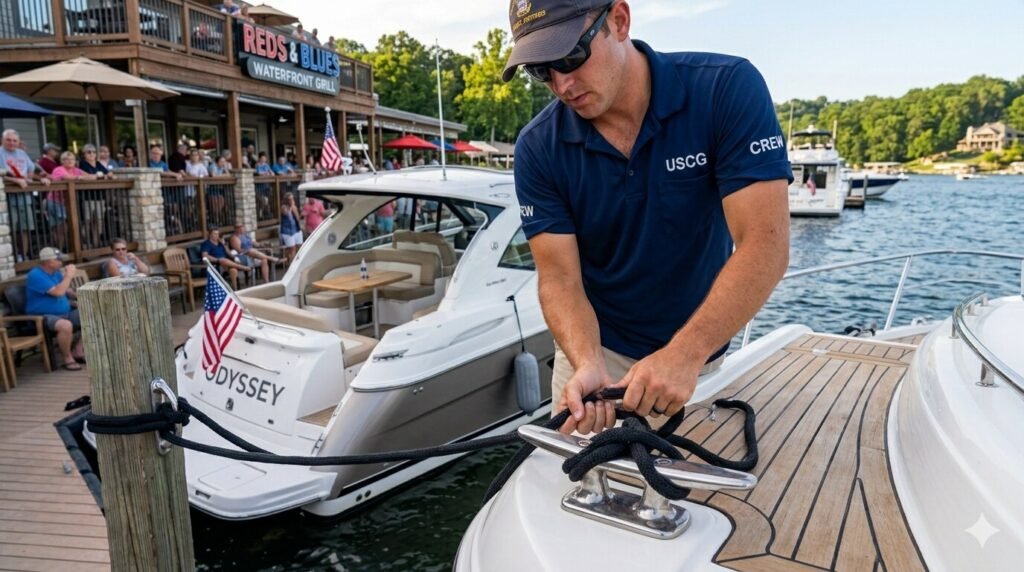
Step five is securing dock lines. Get your bow line on first, then your stern line. Once both lines are on the dock cleats, use them to pull the vessel snug against the dock. Adjust your fenders so they sit correctly between the hull and the dock edge. Double-check both lines are properly cleated before your crew steps ashore.
Handling Wind and Tight Spaces at Lake of the Ozarks Restaurants
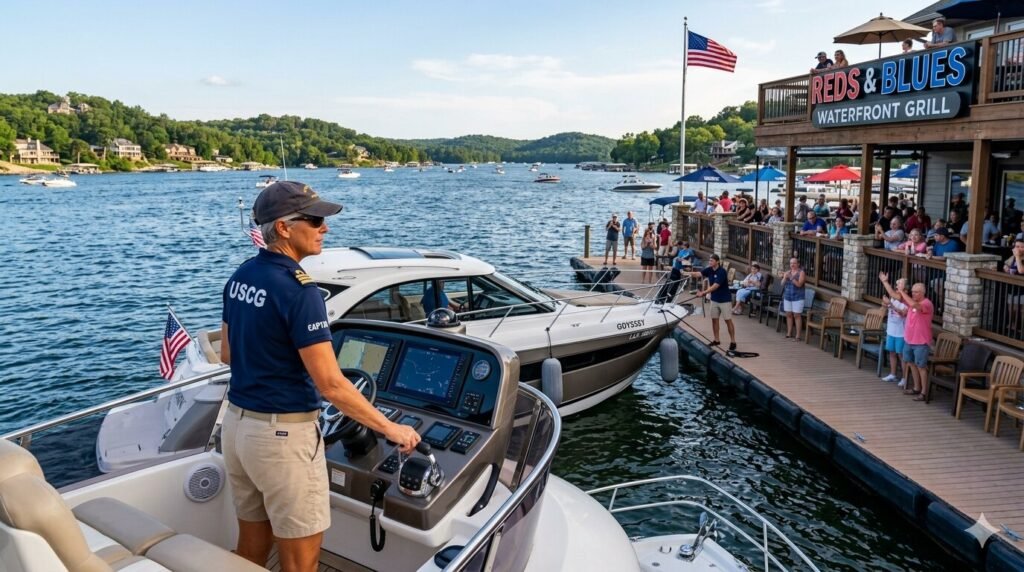
Lakefront restaurants at Lake of the Ozarks present specific challenges that make docking more demanding than open marina situations. Backwater Jacks, Lazy Gators, and Shady Gators all have busy docks that fill up quickly on summer weekends. Boats are arriving and departing constantly. You may have limited space to maneuver and other captains watching your every move.
When wind is pushing you away from the dock, use your engines more aggressively during the approach. Come in at a slightly steeper angle than normal so the wind does not push your stern away before you can get lines on. Have crew ready with the bow line the moment the bow is within reach of the dock cleat. Getting that first line on gives you immediate mechanical control over the vessel regardless of what the wind does next.
When wind is pushing you toward the dock, slow your approach even further. The wind is doing part of your work for you. The risk shifts from drifting away to coming in too fast. Use more reverse and less forward thrust throughout the approach. Your goal is to let the wind bring you in gently while your engines control the angle and prevent contact that is too abrupt.
Tight spaces between other docked vessels require clean pivot control. If the gap is only slightly larger than your vessel, position yourself perfectly parallel before you begin moving into the space. Never enter a tight gap at an angle. Come in straight and use equal reverse on both engines to slide in without the bow or stern swinging into neighboring boats. If the space feels genuinely too tight for your vessel, do not attempt it. Find another space or wait for a larger gap to open up.
When to Let a Professional Captain Handle It
There is no shame in acknowledging when a docking situation is beyond your current experience level. Busy summer weekends at Lake of the Ozarks lakefront restaurants can create genuinely demanding docking environments. Heavy traffic, strong afternoon winds, crowded docks, and the pressure of other people watching all combine to make these situations challenging even for experienced boaters.
Booking a private yacht charter with a USCG-certified captain at Lake Ozark removes this challenge entirely. Your captain has docked at every major waterfront restaurant on the lake hundreds of times. They know the specific quirks of each dock. They know how the wind behaves at each location in the afternoon. They know exactly how much space is needed and how to approach from the right angle every time.
When your captain handles the docking, your group simply enjoys the arrival. No stress. No white-knuckle moments. No risk of an embarrassing or costly docking incident in front of a full restaurant crowd. You step off a well-handled yacht and walk straight into a great afternoon ashore. This is the experience a professional charter delivers every single time.
A crewed charter also means your group can drink and enjoy themselves at the restaurant without anyone needing to stay sober to operate the boat afterward. Your captain remains responsible and focused throughout the entire day. This single factor alone makes a yacht charter at Lake of the Ozarks the most sensible and enjoyable choice for any group planning to visit multiple waterfront restaurants in a single outing.
Frequently Asked Questions
Is docking a twin engine yacht easier than a single engine?
Yes, twin engines give you significantly more control during docking than a single engine setup. You can pivot the boat in place, counteract wind independently, and make very precise adjustments in tight spaces. Single engine vessels rely heavily on helm input and prop walk to maneuver at slow speeds. Twin engine yachts allow you to use each engine independently to steer, stop, and position the boat exactly where you need it. With practice, docking a twin engine yacht becomes a smooth and reliable process.
What is the most common docking mistake on a twin engine yacht?
Coming in too fast is the most common and most costly docking mistake on any vessel including twin engine yachts. High approach speed reduces your reaction time and magnifies the impact of any error in angle or positioning. Many boaters also fail to account for wind drift during the slow final phase of the approach. Deploying fenders before you approach and having crew ready with dock lines eliminates last-minute scrambling. Slowing down earlier than you think necessary is always the right instinct when approaching a busy lakefront restaurant dock.
How do I handle crosswind when docking at a lakefront restaurant?
Crosswind is one of the most common challenges at Lake of the Ozarks docks during summer afternoons. When wind is pushing you sideways, adjust your approach angle to compensate. Come in from slightly further upwind so the wind pushes you toward your target rather than away from it. Use short forward bursts on the upwind engine to hold your angle against the wind. Get your first dock line on as quickly as possible because it gives you immediate control. A USCG-certified captain handles crosswind docking instinctively from years of experience on this specific lake.
Do I need to call ahead to reserve dock space at lakefront restaurants at Lake of the Ozarks?
Some lakefront restaurants at Lake of the Ozarks allow dock reservations and some operate on a first-come basis. Calling ahead is always a good idea on busy summer weekends and holiday periods. Dock space at popular spots like Backwater Jacks and Lazy Gators fills up quickly on Saturday and Sunday afternoons. Arriving early in the morning or later in the afternoon improves your chances of finding open space. Your charter captain will know the current dock policies and best arrival timing for each destination.
What fender setup is best for docking a yacht at a restaurant dock?
Having at least three fenders deployed on the docking side of the vessel is standard practice for a yacht. Position one near the bow, one near the stern, and one in the middle of the hull. Adjust the height of each fender so it sits at the level of the dock edge when the boat is in the water. Round dock pilings sometimes require a fender board for proper coverage. Always deploy fenders before you begin your approach so your crew is free to handle dock lines during the critical final phase of docking.
Can beginners dock a twin engine yacht at a busy restaurant dock?
Beginners can absolutely learn to dock a twin engine yacht, but a busy lakefront restaurant dock on a peak summer weekend is not the ideal place to practice. The combination of traffic, wind, limited space, and time pressure creates a challenging environment. Learning the basic twin engine pivot and stopping techniques in open water or a quiet marina first builds the confidence and muscle memory needed for more demanding situations. For any trip that involves docking at busy Lake of the Ozarks restaurants, booking a crewed charter with a professional captain is the wisest and safest choice for beginners.
How long does it take to get comfortable docking a twin engine yacht?
Most boaters become comfortable with basic twin engine docking maneuvers after five to ten practice sessions in low-pressure environments. The pivot technique, speed control, and wind compensation all require real repetition to become instinctive. Practicing in an empty marina or quiet cove before heading to a busy restaurant dock builds the foundation properly. Many experienced boaters take a formal boating course that includes twin engine handling to accelerate their learning. Working alongside a USCG-certified captain on a charter is also one of the best ways to observe professional technique up close.
What should my crew be doing while I dock the yacht?
Your crew plays an important role in a smooth docking. Assign one person to handle the bow line and one to handle the stern line before the approach begins. Both should be standing ready with lines coiled and fenders checked. No one should be moving around the deck unnecessarily during the final approach. Clear and calm communication between the captain and crew prevents confusion at critical moments. When working with a professional charter captain, they will brief your group clearly on what is expected so everyone knows their role before the dock comes into view.
Final Thoughts
Docking a twin engine yacht at a lakefront restaurant at Lake of the Ozarks is a skill that rewards preparation and practice. Understanding your engines, reading the dock, managing your approach speed, and compensating for wind all come together to create a clean and confident arrival every time.
For groups who want the full lakefront restaurant experience without the stress of handling a large vessel themselves, Yacht Rental Lake Ozark offers private charters with USCG-certified captains who make every dock look effortless. Reach out today to book your charter and enjoy the best waterfront dining and cruising that Lake of the Ozarks has to offer.