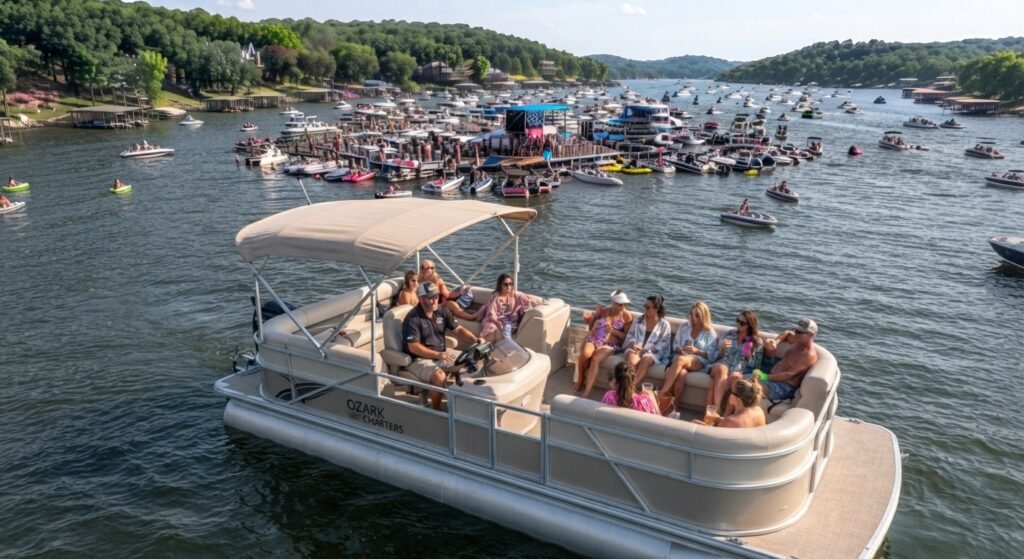
Why Anchoring Distance Matters at Party Cove
From a distance, Party Cove looks like one massive floating party with no real order to it. Get closer and you notice something different. Boats that are not tied into the main raft still carve out their own pocket of water, and that pocket matters more than most visitors realize until something goes wrong.
New arrivals almost always want to be right in the middle of it. The music is loudest there, the energy pulls people in, and nobody wants to feel left out on the edges. It makes sense. But pushing in too close is exactly how a fun afternoon turns into one spent untangling lines or checking for scratches on the hull.
None of this means staying far away from the action. It just means respecting a little breathing room, both for your own boat and for the strangers anchored a few feet away. That small gap between excitement and recklessness is really what this whole guide comes down to.
By the time you finish reading, you should have a much clearer sense of how much space is actually enough, what changes that number, and why the boaters who never seem to have a problem usually have a captain who already knows all of this by feel. It is worth saying up front that none of this is complicated once you have seen it play out a few times. Most of it comes down to paying attention, reading the water, and resisting the urge to squeeze into the first open patch you see.
What Counts as a Safe Distance From the Main Raft Up
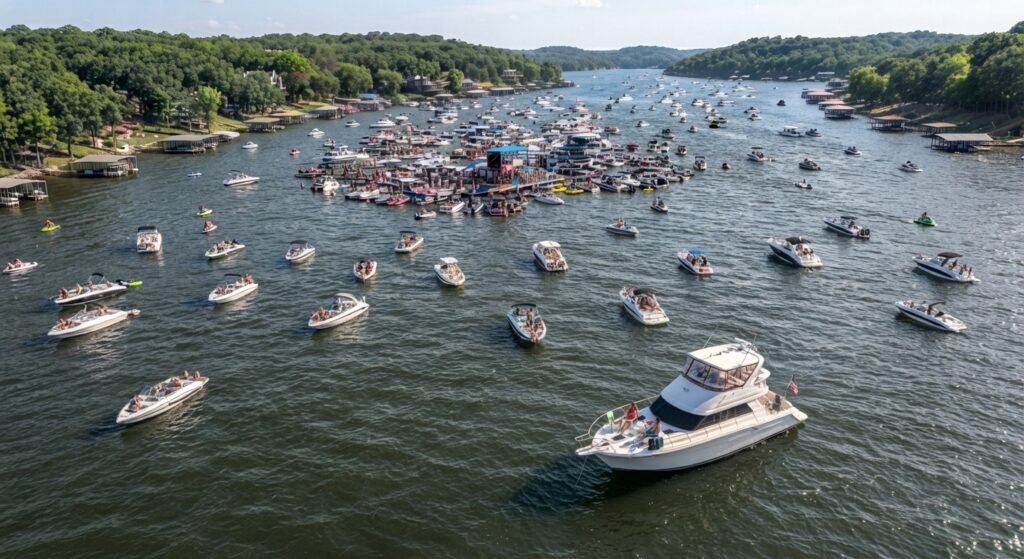
There is no magic number painted on the water at Party Cove. Distance depends on how big the raft has already grown, how many boats are packed around it, and what the water is doing that particular afternoon. Most seasoned boaters use a rough rule anyway, keeping at least one full boat length of open water between their anchor point and the nearest edge of the crowd.
That number tends to grow as the day gets busier. A raft made up of six or seven boats behaves nothing like one stretching across dozens of connected vessels. More boats means more wake bouncing around, more unpredictable drift, and less margin for error if something shifts suddenly.
Holiday weekends push this to the extreme. Once the cove fills past a certain point, even people who have anchored there for years find themselves reassessing their spot every hour or so, since the whole shape of the crowd keeps changing around them.
The real test is simple, even if the exact number never is. Your boat needs enough room to swing on its anchor line without brushing up against anyone else’s. If a light gust would push your hull toward the raft, that spot was too tight from the start. A few boaters even let their boat drift naturally for a minute after anchoring, just to see how much room it actually claims once it settles.
Think of it less like a fixed measurement and more like a feel you develop after a few visits. The boats that end up in trouble are rarely the ones that misjudged distance by a foot or two. They are the ones that never thought about it at all.
Factors That Affect How Far You Should Anchor
Wind does more work here than people give it credit for. A boat sitting downwind of the raft needs noticeably more clearance than one anchored with the wind at its back. Skipping this consideration is probably the single most common mistake first timers make, and it is an easy one to fix with a quick glance at the forecast before leaving the dock.
Depth and anchor type matter too, though they get less attention. A lighter anchor dropped in deeper water can let a boat swing farther than expected, and plenty of boaters never actually test their own equipment until they need it to hold. Knowing how your gear behaves beats guessing every time.
Then there is the boat itself. A twenty foot pontoon and a forty foot yacht do not need the same amount of room, not even close. Bigger boats swing wider simply because of their length and weight, and a spot that works fine for a small runabout might feel cramped the moment something larger anchors nearby. Passenger movement on deck adds a small variable too, since a group shifting around can nudge a boat’s balance just enough to matter.
None of these factors work in isolation either. A large boat anchored downwind on a soft bottom needs far more room than a small one facing into the wind with a solid grip on the lake floor. Reading them together, rather than one at a time, is what separates a lucky guess from an actual safe decision.
How to Judge Distance Without Guessing
Most experienced Party Cove regulars skip the math entirely and just eyeball it. Picture your own boat length, then mentally slide that gap between your bow and the nearest raft. If that image looks tight in your head, it is probably tighter in real life.
Watching the boats already anchored nearby tells its own story. If they are swinging close enough to almost touch, that section of the cove is already too full for a comfortable new arrival. Better to look for a slightly different pocket than to squeeze into a spot that was crowded before you even got there.
Patrol boats occasionally handle this for you, whether they mean to or not. A wave, a slow pass, or a quick word from an officer is usually worth acting on immediately rather than debating. And honestly, asking the boaters already anchored nearby works just as well. Most people at Party Cove are happy to help a newcomer find something that will not end in an awkward bump later in the day.
There is no shame in taking an extra few minutes to get this right. The visitors who end up frustrated later in the day are almost always the ones who rushed the decision early on, just to get settled and start the fun a little sooner.
Risks of Anchoring Too Close to the Raft
Hull damage is the risk everyone thinks about first, and for good reason. Even small waves can push two boats together hard enough to leave a scrape, a dent, or worse. It rarely happens on purpose. It happens because someone anchored a little too close and a little too confidently.
Repair bills add up fast, especially on nicer boats, which makes this one of those mistakes that costs real money for something entirely preventable.
Swimmers complicate the picture even further. People drift between boats constantly at Party Cove, and tight spacing shrinks the room they have to move safely. Visibility drops too, since a crowded cluster of hulls makes it harder to spot someone in the water until they are uncomfortably close. This risk climbs sharply during the busiest stretch of the afternoon, right when the most swimmers are out and boats are still jostling for position.
Beyond the physical risk, tight anchoring just wears people down. Constantly checking lines, watching for drift, and bracing for contact leaves no room to actually relax, and that tension has a way of spreading to the boats around it. One stressed out group can shift the mood of an entire stretch of water.
It is a strange thing to watch happen, but it does happen. A single boat anchored too tight, with its passengers visibly on edge, can make everyone nearby a little more cautious and a little less relaxed than they would otherwise be on a calm summer afternoon.
Benefits of Giving Yourself Extra Space
Give yourself room and most of these worries disappear on their own. Boats anchored with proper clearance let their passengers actually swim, talk, and enjoy the day instead of half watching for contact the whole time.
There is a quieter benefit too. Boats that avoid unnecessary bumps stay in better shape, which matters to anyone who takes pride in their vessel or plans on selling it down the line.
And the effect goes beyond your own group. When most boats anchor with a little consideration, the whole cove moves easier. Swimmers have clearer paths, traffic between rafts flows better, and the entire atmosphere feels less chaotic, even with hundreds of boats packed into the same stretch of water.
It is easy to underestimate how much this adds up across an entire afternoon. A cove full of boats that each left a little extra room ends up functioning almost like a well organized parking lot, even though nobody planned it that way on purpose.
Tips for Choosing the Right Spot Near the Action
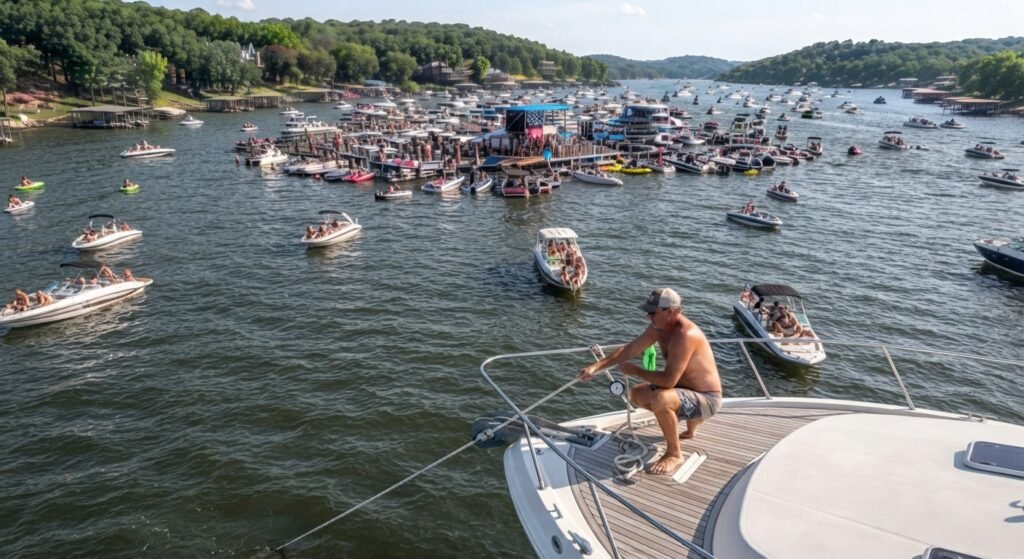
Getting there early is still the single best advantage you can give yourself. An early arrival means studying wind and crowd patterns while there is still room to choose, rather than settling for whatever is left once the cove fills in.
A slow lap around the outer edge before committing is worth the extra few minutes. It often reveals better options than the first open spot near the entrance, especially before things get crowded later on.
Pay attention to the shape the raft is taking too. Some form long snaking lines, others spread wide and loose. Reading that shape helps you tuck in close enough to feel part of things without crowding anyone out.
A short, friendly conversation with nearby boaters solves more problems than people expect. Most visitors are glad to talk through spacing, and a pair of binoculars scanning for open gaps from a distance saves you from drifting in too close while you are still deciding.
None of these tips require any special skill, just a willingness to slow down for a few minutes before committing. That small pause is usually the difference between a spot that works all day and one you end up second guessing by early afternoon.
Why a Charter Captain Gets This Right Every Time
Hiring a professional captain, whether on a yacht or a pontoon, takes this entire decision off your plate. Captains who work Party Cove regularly read wind, crowd density, and water conditions almost instinctively, the kind of feel that only comes from doing it dozens of times.
That experience means guests never have to second guess whether they anchored too close or too cautiously far. Captains find the sweet spot, close enough to stay part of the energy, far enough to avoid any real risk, and guests are free to enjoy the day without thinking about any of it.
Good captains keep adjusting too, nudging position slightly as wind shifts or the crowd moves throughout the afternoon, something most casual boaters would never think to do on their own.
It sounds like a small detail until you have watched it play out over a full day. The boats anchored by a captain rarely need repositioning, while nearby boats without one are often shifting, retying, or drifting closer to trouble than they realize.
For a group celebrating something special, that peace of mind is worth even more. A well positioned charter lets everyone feel fully in the middle of the action without ever creating a problem that needed solving in the first place. Learning to judge this distance yourself is a useful skill, but letting someone who already has takes the guesswork out completely.