
Getting a large group out on the water at Lake of the Ozarks is one of the best experiences the lake has to offer.
But the bigger the group, the more important preparation becomes.
Safety on the water is not optional. It is not something to figure out once you are already out on the lake. It is something every charter guest should understand before they step on board. This is especially true for large group boat rentals at LOTO, where more people on the vessel means more variables to manage.
This guide gives you a complete safety equipment checklist for large group charters at Lake of the Ozarks. It covers legal requirements, essential gear, Missouri boating regulations, and what to look for when choosing a charter company that takes safety seriously.
Why Safety Preparation Matters More for Large Groups
A solo couple on a 2-hour sunset cruise faces a very different safety picture than a group of 14 people on a full-day charter. The risks do not multiply the same way, but the stakes do.
With a larger group, there are more people who may not know how to swim well. There are more people moving around the deck at any given time. There is more activity near the water. There are more chances for someone to lose their footing, lean too far over the rail, or find themselves in a situation they were not prepared for. Group dynamics on a moving vessel require more active awareness than most guests realize until they are already out there.
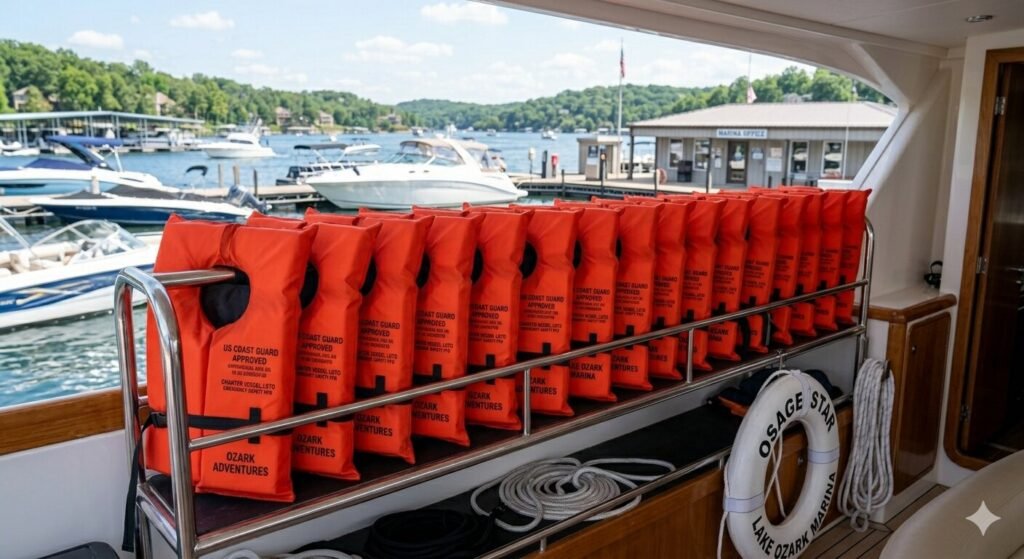
This is why reputable yacht charter companies at Lake of the Ozarks take the safety briefing seriously for every booking, but especially for large groups. A proper safety briefing before departure is not a formality. It is one of the most important parts of the whole experience. Every person on board should know where the life jackets are stored, where the fire extinguisher is located, how to signal for help, and what the boarding and exiting procedures are.
Understanding the safety equipment on board before you depart gives everyone confidence. It also ensures that if something does go wrong, the response is immediate and informed rather than panicked and slow. Safety knowledge does not diminish the fun. It protects it.
U.S. Coast Guard and Missouri Boating Safety Requirements
Before covering the specific gear, it is important to understand the legal framework that governs boat safety at Lake of the Ozarks. Missouri follows both U.S. Coast Guard federal regulations and state-level boating laws enforced by the Missouri State Highway Patrol Water Division.
Every vessel operating on Lake of the Ozarks must comply with these requirements. Reputable charter companies handle this automatically. But as a guest, knowing what is legally required helps you verify that your charter is properly equipped before you depart.
Federal law requires that every vessel carry at least one U.S. Coast Guard-approved personal flotation device for each person on board. On vessels 16 feet or longer, at least one Type IV throwable device must also be on board in addition to individual life jackets. Fire extinguishers are federally required on any motorized vessel with an enclosed engine compartment. Visual distress signals including flares are required for vessels operating on open water after dark or in certain weather conditions.
Missouri state law adds additional requirements. All children under 7 years of age must wear a Coast Guard-approved life jacket at all times while the vessel is underway. Boat operators must carry proof of registration. Sound-producing devices such as a horn or whistle are required for signaling in restricted visibility conditions. Missouri also enforces strict blood alcohol content limits for vessel operators on the water, with the legal limit set at 0.08 percent, the same as for motor vehicles.
Any charter company operating legally at Lake of the Ozarks will have all of this covered. If a company cannot confirm compliance with these requirements when asked, that is a serious red flag.
The Complete Safety Equipment Checklist for Large Group Charters
This is the full checklist every large group should mentally verify before departing on a private boat charter at LOTO. Your captain and charter company should have all of this in place. Use this list to confirm it yourself.
Personal Flotation Devices for Every Person on Board
This is the single most important item on any boat safety checklist. There must be at least one Coast Guard-approved life jacket for every passenger. On a large group charter, that means the vessel needs enough properly rated PFDs to cover your full headcount, including children. Life jackets must be the correct size for each person. An adult life jacket on a child provides almost no real protection.
Before departure, confirm the total number of PFDs on board matches or exceeds your group size. Confirm that children’s sizes are available if children are part of your group. Ask where they are stored so everyone knows without having to search in an emergency. The best charter companies brief every guest on PFD location during the pre-departure safety walkthrough.
Throwable Type IV Flotation Device
In addition to wearable life jackets, every vessel 16 feet or longer must have at least one Type IV throwable flotation device immediately accessible on deck. This is typically a ring buoy or a throwable cushion. It is designed to be thrown to a person who has fallen overboard to keep them afloat while the vessel maneuvers to retrieve them.
On a large group charter, the throwable device should be in a clearly visible and immediately accessible location, not stored in a compartment. Your captain or first mate should be able to grab it and deploy it within seconds. For larger vessels carrying maximum capacity groups, some operators carry two throwable devices as an added precaution.
Fire Extinguisher
Every motorized vessel with an enclosed engine compartment is required by federal law to carry at least one Coast Guard-approved fire extinguisher. Larger vessels may be required to carry more than one depending on their size and configuration.
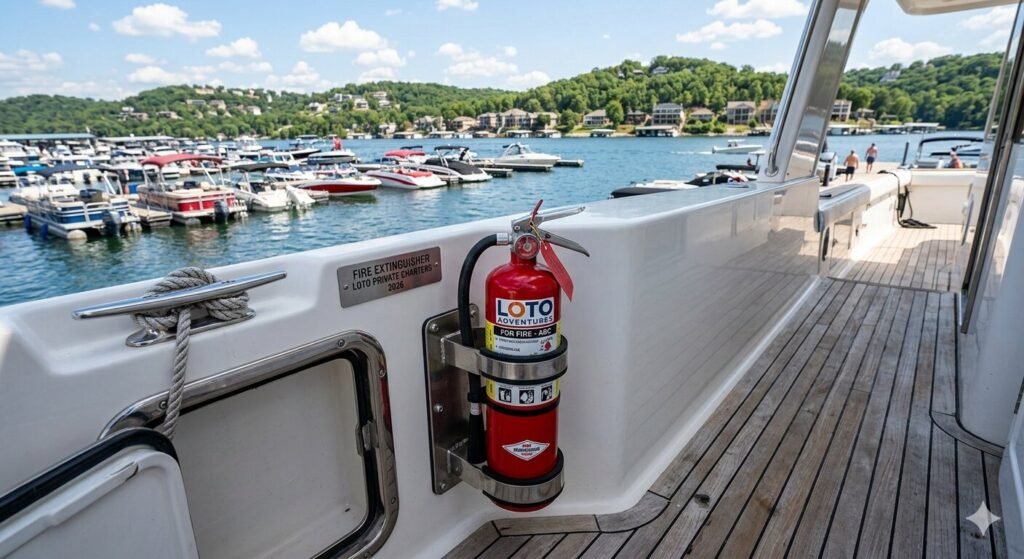
Ask your charter company where the fire extinguisher is located before you depart. It should be fully charged and within its inspection date. Confirm that your captain has reviewed the operation of the extinguisher with the crew. On a large group charter, knowing the location of fire safety equipment is something every adult on board should be briefed on, not just the captain.
Visual Distress Signals and Flares
Visual distress signals are required for vessels operating after dark or during periods of restricted visibility. On a captained charter at Lake of the Ozarks, your operator will handle this. But guests on evening or overnight charters should confirm that the vessel carries current, in-date flares or approved electronic distress signal devices.
Pyrotechnic flares have expiration dates. An out-of-date flare does not meet Coast Guard requirements and may not function reliably in an emergency. This is a detail that guests rarely think to check but it matters.
Sound Signaling Device
A horn or whistle is required on all vessels for use in reduced visibility or to signal intent in close-quarter situations with other boats. On Lake of the Ozarks, where summer boat traffic can be heavy and conditions can change quickly, a functioning sound device is a basic but important piece of safety equipment.
Your charter company should have this covered automatically. It is worth a quick visual confirmation before departure on any large group booking.
First Aid Kit
A well-stocked first aid kit is not legally mandated by federal law for recreational vessels, but it is an absolute standard for any reputable charter company running large group bookings. The kit should include bandages, antiseptic, burn treatment supplies, seasickness medication, and basic pain relief at a minimum.
On a full-day large group charter, minor injuries can and do happen. Someone slips on a wet deck. A child scrapes a knee. Someone gets a mild burn from the sun or from contact with a hot surface. Having a proper first aid kit on board means these situations are handled quickly and calmly without needing to cut the charter short.
Anchor and Anchor Line
An anchor is critical safety equipment on any vessel, not just a convenience item. If the engine experiences a problem in a high-traffic area or near a hazard, dropping anchor immediately stabilizes the vessel and prevents dangerous drift.
On large group charters where the vessel may be anchored for swimming stops or social anchoring near areas like Party Cove, a proper anchor and sufficient anchor line for the water depth are essential. Confirm that your charter vessel carries an anchor rated for its size and weight.
Navigation Lights
Any vessel operating after sunset is legally required to display proper navigation lights. If your large group charter extends into the evening, navigation lights must be functioning correctly. White stern light, red port light, and green starboard light are all required for proper nighttime operation.
This applies to sunset charters and evening cruises. Confirm with your operator that the vessel’s lighting system is fully functional before any after-dark departure.
What to Look for in a Safety-First Charter Company at Lake of the Ozarks
Knowing the checklist is valuable. Choosing a charter company that takes it seriously is equally important.
A reputable yacht charter operator at LOTO will conduct a full safety briefing before every departure without being asked. They will point out the location of every piece of safety equipment on board. They will go over boarding and exiting procedures, swimming stop protocols, and emergency contact procedures. They will not rush through this briefing to get underway faster. Safety-first operators understand that a thorough briefing is part of the service, not a delay.
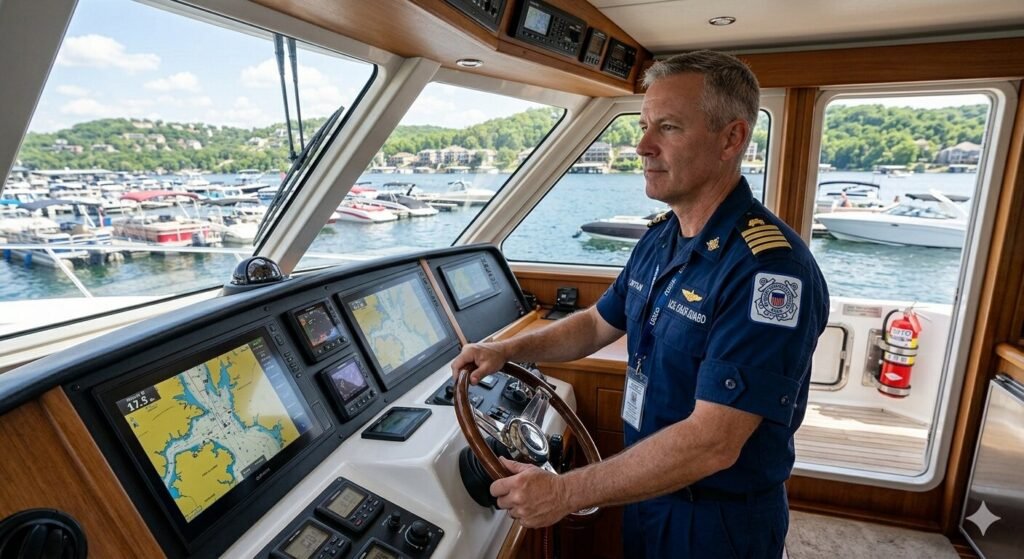
Ask the company directly whether their captains are licensed and certified through the U.S. Coast Guard. A licensed captain has completed formal training in vessel operation, navigation rules, and emergency procedures. On a large group charter, having a certified professional captain at the helm is not a luxury. It is a fundamental safety requirement.
Check whether the vessel itself is regularly inspected and maintained. Well-maintained vessels have fewer mechanical issues on the water. Engines, safety systems, navigation equipment, and structural integrity all require ongoing attention. Charter companies that invest in maintenance are communicating something about how seriously they take the safety of their guests.
Look at reviews specifically for mentions of the safety briefing, captain professionalism, and how the company handled unexpected situations. Guests who have experienced a weather change, a minor emergency, or an unexpected situation mid-charter often write about how the captain managed it. Those reviews tell you more about a company’s safety culture than any marketing language on their website.
Safety Tips for Guests on Large Group Charters at LOTO
Beyond what the charter company provides, there are things every guest can do to contribute to a safer experience on the water.
Stay aware of your surroundings at all times. A moving boat is not the same as standing on dry land. Wet surfaces, changing boat speed, and wake from passing vessels can all affect your balance unexpectedly. Move around the deck carefully, especially when the boat is underway.
Follow the captain’s instructions immediately and without debate. The captain has full authority on the vessel. This is not a formality. In an emergency, hesitation caused by guests questioning instructions can be genuinely dangerous. If the captain says sit down, get back from the rail, or return to the cabin, do it immediately.
Do not lean over the railing. This is one of the most common causes of overboard incidents on recreational vessels. It seems harmless until it is not. Keep a safe distance from the edges of the vessel, especially when the boat is moving or when wake activity is causing the vessel to rock.
Know where the life jackets are before you need them. Do not wait until there is a problem to figure out where the PFDs are stored. Pay attention during the safety briefing. If your group includes non-swimmers or weak swimmers, encourage them to wear a life jacket throughout the charter rather than just during water activities.
Manage alcohol consumption responsibly. Alcohol impairs balance, judgment, and reaction time. On a moving vessel surrounded by deep water, those impairments are significantly more dangerous than they would be on land. Guests enjoying drinks on a LOTO charter should pace themselves and stay mindful of the environment they are in.
Frequently Asked Questions
How many life jackets are required on a large group charter at Lake of the Ozarks?
Federal law requires at least one Coast Guard-approved personal flotation device for every person on board. On a large group charter, that means one properly sized life jacket for every single passenger. Children require correctly sized PFDs. Reputable charter companies at LOTO carry the correct number and sizes for all group configurations.
Are children required to wear life jackets on a boat at Lake of the Ozarks?
Yes. Missouri state law requires all children under the age of 7 to wear a Coast Guard-approved life jacket at all times while the vessel is underway. Many safety experts and charter captains strongly recommend that all children wear life jackets throughout any water outing regardless of age.
Do charter companies at LOTO provide safety equipment or do guests bring their own?
Reputable charter companies provide all required safety equipment as part of the booking. Guests are not expected to bring their own life jackets, fire extinguishers, or distress signals. However, guests are encouraged to familiarize themselves with where equipment is stored during the pre-departure safety briefing.
What should I do if someone falls overboard during a large group charter?
Shout “man overboard” immediately and loudly so the captain hears you. Keep your eyes on the person in the water at all times and point continuously so the captain can navigate back to them. Do not jump in after them unless you are a strong swimmer and the captain directs you to. Throw the Type IV flotation device toward the person in the water immediately.
Is a certified captain required for large group charters at Lake of the Ozarks?
A U.S. Coast Guard licensed captain is strongly recommended and is standard practice for reputable charter companies at LOTO. For captained yacht charters specifically, a licensed operator is a fundamental safety requirement. Always confirm captain certification when booking any large group private charter.
What happens if weather becomes unsafe during a large group charter at LOTO?
Your captain monitors weather conditions continuously throughout the charter. If conditions become unsafe, the captain has full authority to alter course, seek shelter, or return to the marina. Guest safety takes absolute priority over the planned itinerary. Follow the captain’s directions immediately and without question in any weather situation.
Is a first aid kit required on charter boats at Lake of the Ozarks?
A first aid kit is not mandated by federal law for recreational vessels, but it is a standard requirement for any professionally operated charter company. Always confirm that a first aid kit is on board before departing, especially on full-day or large group charters where minor injuries are more likely.
What is the alcohol limit for boat operators at Lake of the Ozarks?
Missouri law sets the legal blood alcohol content limit for vessel operators at 0.08 percent, the same threshold as motor vehicle operation. The Missouri State Highway Patrol Water Division actively enforces boating under the influence laws on Lake of the Ozarks. Guests on captained charters are not operating the vessel, but responsible alcohol consumption remains important for personal safety.