
Lake of the Ozarks is one of the most popular boating destinations in the Midwest. It draws millions of visitors every summer. With all that activity comes a lot of boat traffic near commercial docks, marinas, and waterfront businesses. Knowing how to navigate these areas safely is essential. It protects you, your passengers, dock workers, and other boaters.
This guide covers everything you need to know about boating safely around commercial docks at Lake of the Ozarks. Whether you are on a private yacht charter or piloting your own vessel, these rules and tips apply directly to you.
Why Commercial Dock Areas Demand Extra Attention
Commercial docks are busy places. They handle fuel stops, boat rentals, restaurant arrivals, and charter departures all at once. The activity level near these docks is significantly higher than in open water.
Foot traffic near the water’s edge is constant. Dock workers move quickly between boats. Guests board and disembark. Children sometimes run on docks. All of this happens close to moving water. A wake from a passing boat can throw someone off balance in seconds.
Boat congestion is another major factor. Multiple vessels enter and exit dock areas at the same time. Some boats are moving slowly. Others are repositioning. Captains are watching multiple things at once. In this environment, predictable, slow, and deliberate movement is the only safe approach.
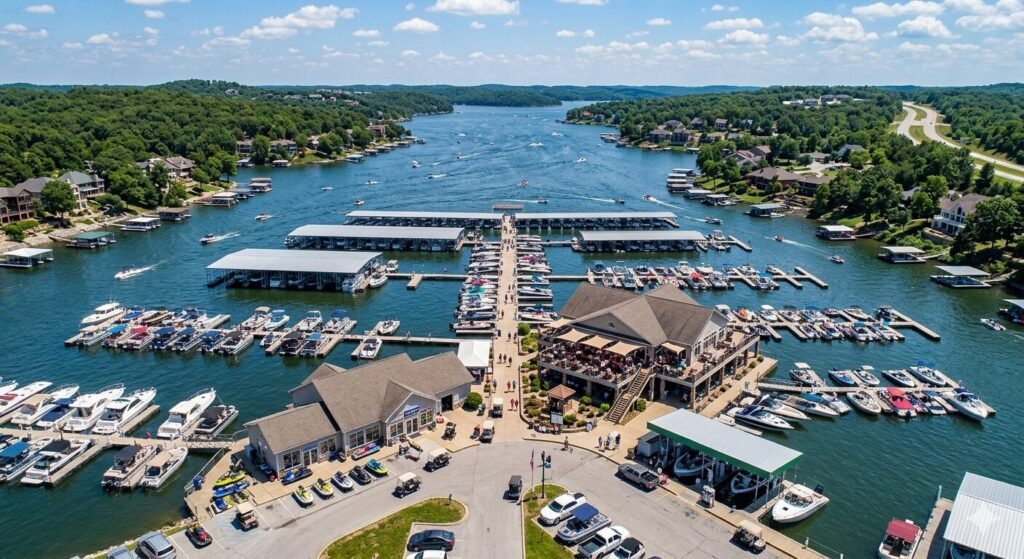
The commercial dock areas around Osage Beach, the Gravois Arm, and the Niangua Arm see some of the heaviest traffic on the lake. Understanding the dynamics of these specific zones will make you a safer and more confident boater in all of them.
No-Wake Zones Near Commercial Docks | What You Need to Know
No-wake zones are the single most important rule to understand near commercial docks. These zones exist specifically to protect people and property in high-activity areas.
A no-wake zone means your vessel must travel at the slowest possible speed that still allows steerage. It does not mean slow. It means minimal. Your boat should produce little to no visible wake at this speed. Most experienced boaters travel between 5 and 7 miles per hour in these zones.
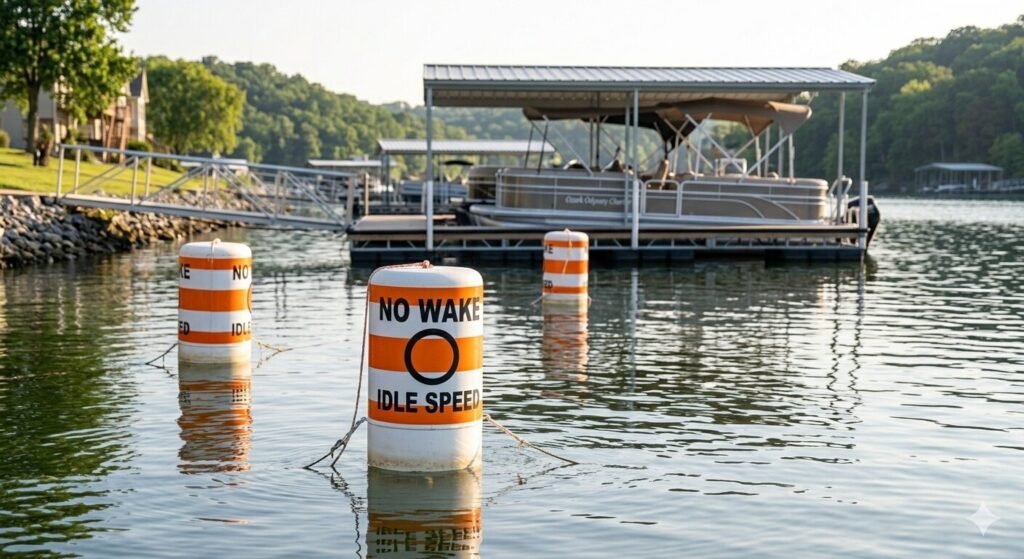
Signs and buoys mark no-wake zones throughout the lake. Orange and white buoys are the most common indicators. Pay attention to their placement. The boundary of a no-wake zone is where the buoys begin, not where the dock structure starts. Many boaters make the mistake of slowing down too late.
Violating a no-wake zone near a commercial dock carries real consequences. Missouri State Highway Patrol Water Division actively enforces these rules on Lake of the Ozarks. Fines are issued regularly. More importantly, a wake in a restricted area can damage docked boats, injure dock workers, and create dangerous conditions for swimmers near shore.
Camden County and surrounding jurisdictions take dock safety seriously. If you are unsure whether a zone is restricted, slow down before you reach it. Caution costs nothing. A fine or an accident costs a great deal more.
Approaching and Departing Commercial Docks Safely
How you approach and leave a commercial dock matters just as much as how fast you travel. Poor technique causes most dock-related incidents on the lake.
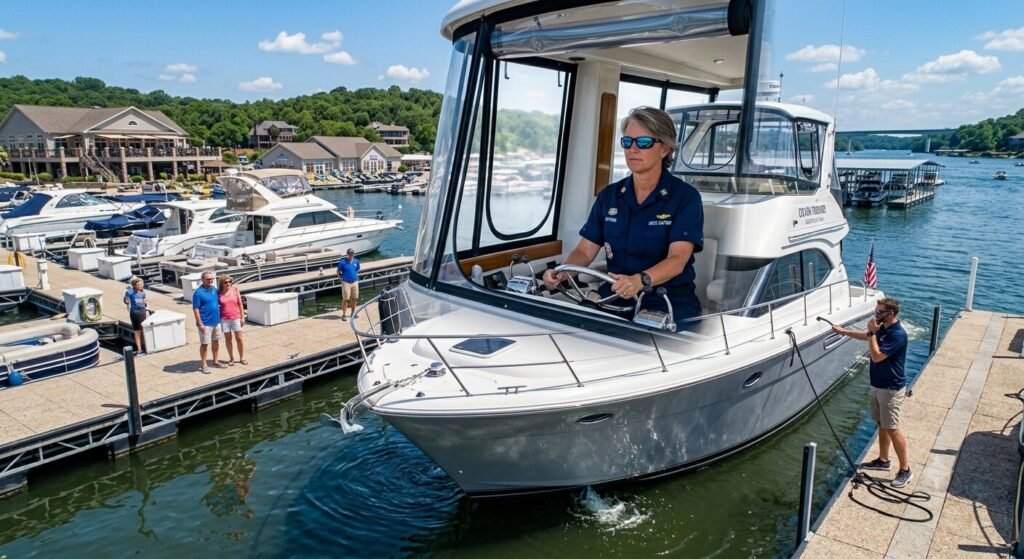
Slow down well before you reach the dock. Do not wait until you are close to reduce speed. Begin your approach from a distance. Give yourself room to adjust. The more time you have, the more control you maintain.
Communicate your intentions. If your vessel has a horn, use it when appropriate. Make eye contact with dock workers when possible. A simple hand signal indicating where you intend to tie up prevents confusion. Dock workers appreciate when captains are clear and deliberate.
Approach at an angle, not head-on. A slight angle allows you to pivot the stern toward the dock as you slow. This gives you more control during the final approach. Coming in straight at speed leaves you little room to correct if something changes.
Account for wind and current. Wind at Lake of the Ozarks can shift quickly. Current near dock areas varies depending on water levels and nearby boat traffic. Always factor these in before committing to your final approach angle. Experienced captains assess wind direction the moment they begin their approach.
When departing, check your surroundings before engaging the throttle. Look for swimmers, kayakers, paddleboarders, and other vessels. Announce your departure to dock staff when possible. Back out slowly before turning. Sudden forward movement from a dock can create dangerous wash in tight spaces.
Right-of-Way Rules in Dock Areas and Marinas
Understanding right-of-way is critical near commercial docks. Confusion about who has priority leads to close calls and collisions.
Vessels leaving a dock have less priority than vessels already underway. If a boat is moving through a channel, a departing vessel should wait for a clear opportunity before pulling out. Do not assume the moving vessel will yield to you.
Vessels entering a marina travel slower and have less maneuverability. Boats already inside a marina or dock area typically have the right of way over those entering. Give inbound vessels room to complete their approach before you begin yours.
Powered vessels yield to human-powered craft in close quarters. Kayaks, canoes, and paddleboards are common near commercial docks, especially near restaurants and waterfront attractions. These craft are quiet and can appear quickly. Always scan for them before moving.
USCG regulations apply on all navigable waters including Lake of the Ozarks. The Inland Navigation Rules govern right-of-way in all situations. When in doubt, yield. Being cautious does not slow you down meaningfully. It does prevent accidents.
Your USCG-certified captain on a Yacht Rental Lake Ozark charter knows these rules completely. They apply them every time they enter or exit a dock area. Watching an experienced captain work a commercial dock is one of the best ways to understand how it should be done.
Fuel Dock Safety | A Separate Set of Rules
Fuel docks at Lake of the Ozarks require extra attention. They are active, congested, and carry specific safety requirements that differ from regular docking.
Turn off all engines before fueling. This is not optional. It is a safety requirement at every fuel dock on the lake. Running engines during fueling creates ignition risk. Follow this rule without exception.
No smoking at fuel docks. Gasoline fumes accumulate near the water’s surface. Even a small spark can ignite them. Keep all open flames and cigarettes away from the fuel dock area at all times.
Tie up securely before fueling begins. A boat that drifts during fueling creates a dangerous situation. Use bow and stern lines. Make sure the vessel is stable before the fuel dock attendant begins.
Blower fans are mandatory after fueling on enclosed engine compartments. Run the blower for at least four minutes before restarting the engine. This clears any accumulated fumes from the bilge. Skipping this step is one of the leading causes of boat fires at fuel docks.
Keep the fuel nozzle in contact with the fill neck during fueling. This prevents static buildup. Do not top off the tank. Leave space for fuel expansion. Overfilled tanks can spill fuel into the water, which is both an environmental violation and a fire hazard.
Fuel dock workers at Lake of the Ozarks are experienced. Follow their directions. They know the specific characteristics of their facility. Their guidance is always worth taking seriously.
Protecting Other Boaters, Swimmers, and Dock Workers
Boating safety near commercial docks is not just about following rules. It is about being aware of the people around you and making decisions that protect them.
Swimmers near docks are especially vulnerable. They are low in the water and hard to see. Near restaurants, waterfront bars like Backwater Jacks and Shady Gators, and resort docks, swimmers may enter the water unexpectedly. Always scan the water around dock areas before moving your vessel.
Dock workers move fast. They are securing lines, handling fuel, loading gear, and managing guest arrivals all at once. A wake that rocks their dock can knock them off their feet. A fast approach gives them no time to react. Treat every person on a dock as someone you are responsible for keeping safe.
Personal watercraft operate near commercial docks frequently. Jet skis and personal watercraft can appear suddenly and move in unpredictable patterns. Keep a wide margin around them. They can stop and turn faster than most larger vessels.
Large charter vessels and pontoon boats have limited visibility at slow speeds. Their captains may not see you if you approach from certain angles. Do not pass closely behind a large vessel that is maneuvering. Give them plenty of space.
When you are on a captained yacht charter from Yacht Rental Lake Ozark, your captain monitors all of this continuously. You can focus on enjoying your time on the water while they manage the complexity of dock navigation and passenger safety.
Local Knowledge | Commercial Docks Specific to Lake of the Ozarks
Lake of the Ozarks has dozens of commercial docks spread across its 1,150 miles of shoreline. Some are busier than others. Knowing the specific characteristics of key dock areas helps you plan accordingly.
The Osage Beach corridor contains a high concentration of commercial marinas, restaurant docks, and fuel stops. This area sees heavy traffic throughout the summer season. Patience and slow speeds are essential here. Plan extra time if you are docking in this corridor during peak hours.
Docks along the Gravois Arm tend to be somewhat less congested than the main channel areas. However, the arm has narrower sections where wakes bounce off both shorelines. Even moderate speed creates conditions that can be problematic near docks on this arm.
The area near Bagnell Dam has specific navigation restrictions. The dam zone is marked and boating near the structure itself is prohibited. Commercial docks in the nearby communities operate under standard rules, but the proximity to the dam means current conditions can vary. Your captain will account for this on any charter routing through this area.
Party Cove attracts massive crowds on summer weekends. While not a traditional commercial dock zone, the volume of anchored vessels and moving boats creates conditions similar to a busy marina. Speed and wake awareness are just as critical here as they are at any formal dock facility.
Frequently Asked Questions
What is the legal speed limit near commercial docks at Lake of the Ozarks?
There is no single posted speed limit that applies to all dock areas. The requirement in no-wake zones is the slowest speed that maintains steerage, which is typically around 5 to 7 miles per hour for most vessels. Outside of marked no-wake zones, Missouri law requires boaters to operate at a reasonable and prudent speed given the conditions. Near commercial docks, that means slowing down significantly even before you reach the marked zone. Err on the side of slower whenever you are near people and structures.
Who enforces boating safety rules at Lake of the Ozarks?
The Missouri State Highway Patrol Water Division is the primary enforcement agency on Lake of the Ozarks. They patrol the lake regularly throughout the boating season. Camden County and surrounding county sheriff departments also have water patrol presence. The U.S. Coast Guard has jurisdiction over all navigable waters including this lake. Violations can result in fines, citations, and in serious cases, loss of boating privileges.
What should I do if my wake accidentally damages a docked boat?
Stop and assess the situation. Do not leave the area. Approach the dock carefully and check whether anyone was injured and whether the vessel or dock sustained damage. Exchange contact and insurance information just as you would in a vehicle accident. Report the incident to Missouri State Highway Patrol Water Division if there is property damage or injury. Attempting to leave the scene of a boating accident is a criminal offense in Missouri.
Are there specific docking rules for large charter vessels versus smaller boats?
Large vessels require more space and take longer to stop. Commercial dock operators typically have designated areas for larger charters and pontoons. Always communicate your vessel size when arranging a dock reservation. USCG regulations apply to all vessels equally regardless of size. However, larger vessels carry additional responsibility because their wakes and mass create greater potential impact on nearby boats, swimmers, and dock structures.
How do I identify a no-wake zone buoy versus a regular navigation buoy?
No-wake zone buoys are typically orange and white. They may have text or symbols indicating the restriction. Standard navigation buoys are red or green and mark channel boundaries. If you see orange and white buoys forming a line across or along a waterway, treat that as a no-wake boundary and reduce speed immediately. When in doubt, slow down and read the signage attached to the buoy. Taking a few extra seconds to read a sign is always better than entering a restricted zone at speed.
Can I anchor near a commercial dock for lunch or swimming?
Anchoring near commercial docks is generally discouraged and sometimes prohibited. Commercial docks need clear access lanes for arriving and departing vessels. Anchoring in those lanes creates hazards for everyone. If you want to stop near a waterfront restaurant or attraction, use their designated guest dock if one is available. Call ahead to confirm availability. Many popular waterfront businesses at Lake of the Ozarks have limited guest docking and require advance notice, especially on busy weekends.
What should passengers do during a dock approach on a charter?
Passengers should remain seated during any dock approach or departure. Avoid standing near the bow or stern during maneuvering. Keep arms, legs, and personal belongings inside the vessel and away from the dock edge until the captain gives the all-clear. Do not try to step off the boat before it is fully secured. Your captain will tell you when it is safe to disembark. Following these simple steps prevents the majority of passenger injuries that occur during docking.
How does boat insurance apply to dock damage incidents at Lake of the Ozarks?
Boat insurance typically covers liability for damage caused to other vessels and structures, including commercial docks. Coverage limits and specific terms vary by policy. If your wake or vessel causes damage at a commercial dock, your liability coverage would generally apply. However, intentional rule violations, such as speeding in a no-wake zone that results in damage, can affect your coverage. Review your policy before boating season and ensure your liability limits are adequate for the type of boating you plan to do on Lake of the Ozarks.
Book a Safe and Comfortable Charter on Lake of the Ozarks
Navigating commercial docks safely comes naturally with experience. When you book a captained yacht or tritoon charter with Yacht Rental Lake Ozark, you get an experienced USCG-certified captain who handles every dock approach, departure, and transit with skill and precision. You focus on the experience. They focus on the safety.
From Camden County coves to the busiest waterfront spots in Osage Beach, your captain knows this lake and its dock areas completely. Book your charter today and enjoy Lake of the Ozarks the right way.