Guides

Guides

Best Water Toys for Floating Behind a Large Cruiser Yacht at Lake of the Ozarks

Best Water Toys for Floating Behind a Large Cruiser Yacht at Lake of the Ozarks Some boat days at Lake of the Ozarks are just okay. You anchor up. People swim for twenty minutes. Then they climb back on board and sit around. By 2pm, half the group is ready to head back to the marina. Other boat days at LOTO are the ones people talk about for years. The difference, more often than not, comes down to what you brought with you into the water. The right water toys transform a parked yacht into a floating playground. They keep energy levels high. They give kids something to do for hours. They give adults a reason to stay in the water instead of retreating to a deck chair. And on a large cruiser yacht with a proper swim platform and stern space, you have the best possible launchpad for a serious water toy setup. This guide covers the best water toys specifically suited to floating behind a large cruiser at Lake of the Ozarks. Not generic lists. Real picks, real reasons, and real advice for how to set them up so everything works together beautifully on the water. What Makes LOTO the Perfect Lake for Water Toys Before getting into specific toys, it helps to understand why Lake of the Ozarks is particularly well suited to this kind of setup. The lake covers over 54,000 acres with more than 1,150 miles of shoreline. That is a lot of coves, inlets, and sheltered anchorage spots where a large cruiser can park and deploy a full water toy setup without worrying about heavy main channel traffic. The coves on the Osage arm and the Grand Glaize arm are especially popular for anchored boat days. The water in these sheltered areas stays relatively calm even on busy summer weekends. The bottom conditions, mostly sand and gravel in the four to ten foot range, are ideal for sand anchors and independent toy anchoring systems. Water temperatures at LOTO reach the mid to upper 80s Fahrenheit during peak summer months. That is warm enough to stay in the water for hours without discomfort. Combined with the lake’s generally good water clarity in the upper arms, you have conditions that make extended water toy use genuinely enjoyable rather than something people quit after thirty minutes because they are cold. Large cruiser yachts also give you something smaller boats cannot. A proper swim platform. A wide, low stern step. Cleats and rails to tie off tether lines. And the hull space to float significant gear alongside the boat without crowding. These physical features matter when you are deploying multiple water toys simultaneously. The Best Water Toys for Behind a Large Cruiser at LOTO These picks are organized by category. Most setups at LOTO use a combination across categories rather than just one type of toy. The goal is to have something for every person in your group, at every energy level, at every age. Giant Inflatable Islands A giant inflatable island is the anchor piece of any serious floating setup. It gives everyone a place to be in the water without actually swimming. People lounge on it. Kids play on it. It becomes the social hub of the floating area. The Intex Mega Island is one of the most popular choices for LOTO boat days. It holds up to eight adults comfortably. It has integrated cup holders, perimeter grab handles, and a built-in cooler section in some configurations. It inflates to a manageable size for storage on a large cruiser and deflates quickly when it is time to head in. The Sun Pleasure Giant Inflatable Floating Island is a premium alternative with better materials and a more stable structure in mild wake conditions. It costs more but it lasts significantly longer with regular use. For groups with kids, look for islands with built-in shade canopies. Afternoon sun at LOTO is intense. A shaded section on the island keeps younger children comfortable and prevents the setup from getting abandoned at 1pm because it is too hot. Water Trampolines Nothing burns energy like a water trampoline. For families with kids between six and sixteen, a water trampoline is genuinely the single best investment for a LOTO boat day. The Rave Sports Aqua Jump Eclipse 150 is the gold standard for recreational lake use. It has a 150 inch diameter jumping surface. The perimeter is surrounded by a foam safety border. It includes an entry ladder and a spring-free jumping mat that is safer than traditional coiled spring designs. It anchors independently with a provided anchor line so it does not need to connect directly to the boat. Position it fifteen to twenty feet off the stern of your cruiser. This keeps the jumping zone separate from the main swim area and swim platform traffic. Attach a secondary tether line from the trampoline to the boat as a backup to the anchor, especially in coves where afternoon wind picks up. The Blast Zone Aqua Park series adds a connected slide to the trampoline format, giving kids a launch ramp and a water slide combined in one unit. These are larger and require more space but for a big group with several children, the extra engagement is worth the footprint. Inflatable Slides and Climbing Walls Teenagers especially get bored fast on a boat day if there is nothing to actually do. An inflatable climbing wall with attached slide solves this problem immediately. The Rave Sports Aqua Ramp attaches directly to the swim platform of a large cruiser and extends outward over the water. It gives riders a raised launch platform for slides, jumps, and dives. It is strong enough for adults and exciting enough to keep teenagers genuinely entertained. For a freestanding option that anchors independently from the boat, the WOW Sports Aqua Slide series includes a floating base, a climbing wall on one side, and a slide on the other. It works well when you want to create more

Guides

How to Create a Floating Lounge Area With Multiple Water Toys at Lake of the Ozarks

How to Create a Floating Lounge Area With Multiple Water Toys at Lake of the Ozarks Picture this. Your yacht is anchored in a quiet cove at Lake of the Ozarks. The sun is high. The water is warm. And right off the back of the boat, you have built a complete floating world. A lounger here. A giant inflatable island there. A cooler floating within arm’s reach. Kids on a water trampoline. Adults relaxing on a foam mat. Everyone is happy. Nobody wants to leave. That is what a well-set-up floating lounge area looks like. It does not happen by accident. It takes a little planning, the right gear, and knowing how to connect everything so it stays together and stays safe. But once you nail it, it becomes the centerpiece of every Lake of the Ozarks boat day you ever plan again. This guide shows you exactly how to build one from scratch. Why a Floating Lounge Setup Changes Your Entire Day on the Water Most boat days at LOTO follow the same pattern. You anchor up. People swim for a bit. Then they climb back on the boat and sit. Then someone suggests moving. The day feels scattered. A floating lounge area changes the whole dynamic. When you have a proper floating setup off the stern, the water becomes a destination instead of just a place to swim through. People stay out longer. They relax more. The energy of the group is completely different when everyone has a comfortable spot in the water rather than crowding back onto the deck. It also makes a Lake of the Ozarks day feel genuinely luxurious. The coves on the Osage arm and the Grand Glaize area are already stunning. Add a well-arranged floating setup and your anchorage looks like a private resort. For families, it gives kids a contained area to play safely. For adults, it creates a social zone that is cooler and more relaxed than sitting on a hot deck in the afternoon sun. For everyone, it turns a good boat day into a great one. Planning Your Floating Lounge Before You Leave the Dock The biggest mistake people make is showing up with a pile of inflatables and no plan for how they connect. Start with a layout in your head before you inflate anything. Think about how many people are in your group. Think about what they want to do. Some people want to lounge and float. Some want to play. Kids need different things than adults. A good floating setup serves everyone. A basic structure that works well for most groups has three zones. First, a central lounge zone with large flat inflatables or foam mats where people can lie down, sit, and relax. Second, an activity zone slightly further from the boat with a water trampoline, a climbing structure, or a slide. Third, a utility zone right at the swim platform with a floating cooler and a floating tray for snacks and drinks. Once you know your zones, figure out how they connect to the boat and to each other. Every piece of your setup needs a tether line. Nothing floats free. That is the rule that keeps your setup together and keeps the lake safe for other boats. Make a checklist at home. Inflatables are easy to forget. Tether lines are easy to forget. A pump is easy to forget. Write it all down the night before and pack it together. Nothing ruins a floating lounge setup faster than arriving at your anchorage and realizing you left the connectors at home. The Essential Gear for a Proper Floating Lounge Area You do not need to spend a fortune. But you do need the right pieces. Large Inflatable Islands and Loungers The foundation of your floating lounge is a large, stable inflatable. Brands like Intex, Bestway, and Sun Pleasure make giant inflatable islands in the 8 to 15 foot range that comfortably hold four to eight adults. Look for models with built-in cup holders, handles around the perimeter, and multiple air chambers. Multiple chambers are important. If one section loses air, the whole island does not sink. The Intex River Run inflatable island and the Sun Pleasure Mega Island are both popular choices for LOTO boat days. They are wide enough for multiple people, stable enough that you can move around on them without tipping, and bright enough to look great in photos. Foam Water Mats Foam floating mats are underrated and extremely practical. They do not need inflation. They are nearly indestructible. They float flat and stable in calm cove water. A good quality foam mat in the 6 by 18 foot range gives six to eight people room to lie down, sit, and move around comfortably. The Floating Oasis mat and the WOW Sports foam water mat are both well-reviewed options. They roll up for easy storage and last for years with basic care. Foam mats work especially well as connectors between inflatable islands. Lay a mat between two larger inflatables and suddenly your floating lounge has a walkway between sections. Water Trampolines A water trampoline earns its space on any group boat day with kids. It provides hours of independent entertainment and keeps the energy level high without requiring adult supervision for every single jump. Look for a trampoline with a built-in ladder or entry step and a perimeter handle ring for safety. The Rave Sports Aqua Jump Eclipse series is a strong choice for Lake of the Ozarks use. It anchors independently with its own anchor line and tether system and does not need to be directly attached to the boat. Position the water trampoline slightly further from the main lounge zone. This keeps jumping activity separate from the relaxation area and reduces the splash zone for people trying to actually relax. Inflatable Slides and Climbing Platforms For families with older kids and teenagers, an inflatable climbing wall with slide adds a vertical dimension to your floating setup. These

Guides

Underwater Video Ideas for Documenting Your Lake of the Ozarks Boat Vacation

Underwater Video Ideas for Documenting Your Lake of the Ozarks Boat Vacation Most people come back from a Lake of the Ozarks boat vacation with hundreds of photos from the deck. Sunsets. Group shots. Cold drinks in the hand. The usual stuff. But the real magic at LOTO happens below the waterline. And almost nobody captures it. Underwater video at Lake of the Ozarks is one of the most underused and most rewarding ways to document a boat vacation. The footage is cinematic. It is different from anything your friends have seen before. And it tells the story of your day on the water in a way that a deck selfie simply never will. This guide covers everything you need. The best shots to get. The right gear. The creative techniques. The editing tips. And the specific moments at Lake of the Ozarks that are worth pointing your camera at beneath the surface. Why Underwater Video Makes Your LOTO Vacation Memorable Think about the last boat trip video you watched. Someone standing at the bow. Someone jumping off the back. A wide shot of the lake. Maybe a slow-motion clip of a wake spraying up. It is fine. But it all looks the same. Underwater footage is different. It has texture. It has light. It has movement you cannot replicate above the surface. The way sunlight filters down through lake water and breaks into shifting patterns on the bottom is genuinely beautiful. The way bubbles trail upward when someone jumps in. The way legs kick near the surface while the lake stretches deep and quiet below. This is the footage that makes people stop scrolling. Lake of the Ozarks is a particularly good location for underwater video. The lake covers over 54,000 acres. It has coves, rocky shorelines, sandy bottom areas, and open water sections each with their own visual character underwater. The water clarity varies by season and location, but in the right spots and at the right time of year, visibility is solid enough to capture genuinely impressive footage. Beyond the aesthetics, underwater video documents experiences that photos simply miss. The nervous energy of someone’s first cliff jump, seen from below. The laughter breaking the surface as a group plays in the water. A child discovering they can hold their breath and touch the bottom for the first time. These are real moments. They deserve to be captured properly. The Gear You Need and What Actually Works You do not need expensive professional equipment to get great underwater video at Lake of the Ozarks. But you do need the right gear. The wrong camera in the wrong housing produces blurry, dark, frustrating footage that ends up deleted before you get home. Action cameras are the best starting point for most people. The GoPro Hero series is the most popular choice for good reason. It is compact, durable, genuinely waterproof to significant depths, and produces excellent 4K footage in good light conditions. The GoPro Hero 12 and Hero 13 models offer improved low-light performance over older versions, which matters in deeper or murkier lake water. The DJI Osmo Action 4 is a strong competitor to GoPro at a similar price point. It handles color well underwater and has excellent image stabilization which reduces the shakiness that amateur underwater footage often suffers from. Both cameras can be handheld, mounted to a pole grip, or attached to a mask or snorkel for hands-free footage. Smartphone housings are a budget-friendly option. Brands like Kraken, Watershot, and DIVEVOLK make housings for most major iPhone and Android models. The image quality from a modern smartphone in a quality housing is genuinely good in bright, shallow water. In deeper or murkier conditions, dedicated action cameras pull ahead significantly. Underwater lighting is worth considering even for lake vacation footage. Natural light drops off quickly below the surface, even in shallow water on sunny days. A small clip-on LED light like the Kraken Hydra 1000 or the Light and Motion Sola significantly improves color and clarity below four or five feet. It is not essential for surface shots but makes a real difference for anything deeper. A wrist mount or pole grip keeps your hands free while swimming and allows you to position the camera more deliberately than simply holding it out in front of you. A 12 to 16 inch underwater pole grip gives you reach to position shots under the hull, around swimmers, or close to the lake bottom without having to get your face in the water. One piece of gear most people overlook is a red or magenta filter for their action camera. Lake water filters out warm colors quickly. Without a correction filter, underwater footage comes out with a heavy blue or green cast. A clip-on red filter for shallow water or a magenta filter for clearer water restores natural color and makes footage look dramatically more professional with no additional editing required. The Best Underwater Shots to Get at Lake of the Ozarks Having the gear is one thing. Knowing what to point it at is everything. These are the specific shots that produce the most compelling underwater footage on a Lake of the Ozarks boat vacation. The hull shot from below is one of the most cinematic frames you can get. Position yourself below and slightly behind your anchored yacht. Point the camera upward. The hull fills the frame from below, the surface light breaks around it, and the depth of the lake stretches down behind you. It is a shot that immediately communicates scale, adventure, and the feeling of being in the water. It works best when the boat is still and the surface is relatively calm. The jump entry sequence is high-energy and always entertaining. Set your camera on a waterproof floating mount or have someone in the water hold it facing upward toward the surface. As someone jumps from the deck or the swim platform, the camera captures the explosive entry from below. The splash and

Guides

How to Secure Floating Coolers to Your Yacht While Anchored

How to Secure Floating Coolers to Your Yacht While Anchored You anchor up at Lake of the Ozarks. The sun is out. The water looks perfect. You drop your floating cooler in and within minutes it has drifted halfway across the cove. It happens to almost everyone. Floating coolers are one of the best additions to a day on the water. They keep drinks cold and within reach. They free up deck space. They make a hot afternoon a whole lot more enjoyable. But without the right setup, they drift. They get tangled. They bump into other boats. Worst case, they disappear entirely. This guide covers exactly how to keep your floating cooler right where you want it. Every method here is practical, simple, and proven to work on real lake days at Lake of the Ozarks. Why Floating Coolers Drift More Than You Expect Most people underestimate how much a floating cooler moves once it hits the water. Wind is the biggest factor. Even a light breeze pushes a floating cooler surprisingly fast. At Lake of the Ozarks, afternoon winds pick up quickly, especially in open coves. Boat wake is another issue. The lake sees heavy traffic on weekends. Every passing boat sends waves your way. Those waves push your cooler further from the yacht with each one. Current plays a role too. Lake of the Ozarks has areas with subtle water movement, particularly near the main channel. It is easy to miss until your cooler has already moved twenty feet away. Understanding these forces helps you choose the right securing method. A calm, sheltered cove needs a different setup than an exposed anchorage near the main channel. The Best Methods to Secure a Floating Cooler to Your Yacht There is no single method that works perfectly in every situation. The best approach depends on your cooler type, your anchorage spot, and how long you plan to stay put. Here are the most reliable methods used by experienced boaters at Lake of the Ozarks. Rope and Cleat Attachment This is the simplest and most commonly used method. Take a floating rope of around 10 to 15 feet and tie one end to the cooler handle. Tie the other end to a stern cleat on your yacht. Use a bowline knot. It is secure, easy to untie, and will not slip under load. Keep the rope length short enough that the cooler stays close to the boat. Too much slack and the cooler still drifts freely on the end of the line. Always use floating rope specifically. Sinking rope drags the cooler down and can wrap around the propeller if the engine is running. Carabiner Clip System A carabiner system makes attaching and detaching your cooler fast and easy. Attach a marine-grade carabiner to the cooler handle. Run a short floating line from the carabiner to a fixed point on the yacht. The carabiner clips on and off in seconds, which is useful when you want to bring the cooler on board quickly. This method works especially well when you have multiple coolers. Each one gets its own line and carabiner. Everything stays organized and within arm’s reach. Anchor Spike or Sand Anchor When you want the cooler floating away from the boat rather than against it, a small anchor works well. A sand anchor or spike anchor drops to the lake bottom and holds the cooler in position independently of the yacht. The cooler floats freely within the length of its tether but stays in one spot. This method suits shallow, calm coves perfectly. The anchored cooler becomes its own little floating station that guests can swim to and grab drinks from. At Lake of the Ozarks, where many popular anchoring spots have sandy or gravel bottoms in four to eight feet of water, this approach works extremely well. Buddy Line Between Multiple Coolers If you have two floating coolers, connect them to each other with a short line. Then attach one cooler to the yacht. This keeps both coolers together and reduces the number of separate lines you are managing. The weight of two connected coolers also creates more resistance against wind and wake. Bungee Cord as a Shock Absorber Boat wake creates sudden jerking forces on your cooler tether. A rigid rope absorbs that shock directly through the cooler handle, which can crack cheaper cooler lids and handles over time. Adding a marine bungee cord between your rope and the cooler handle acts as a shock absorber. The bungee stretches with each wave and releases slowly, reducing stress on both the cooler and the attachment point. This is a small addition but it makes a noticeable difference on busy lake days. Choosing the Right Attachment Points on Your Yacht Where you attach the cooler matters as much as how you attach it. Stern cleats are the most common and convenient attachment points. They are strong, properly reinforced, and positioned at the back of the boat where coolers naturally sit in the water. Swim platform rail fittings work well on yachts with an aft swim platform. The cooler floats just behind the platform, making it easy to grab drinks without getting fully in the water. Avoid attaching cooler lines to non-structural fittings like cup holders, canvas snaps, or decorative hardware. These are not designed to handle the repeated load of a floating cooler in wake conditions. On a luxury charter yacht at Lake of the Ozarks, your crew can help identify the best attachment points for your specific vessel. Every yacht has slightly different stern configurations, and an experienced crew member knows exactly where a tether line should and should not go. Best Coolers for Floating at Lake of the Ozarks Not all floating coolers are equal. Choosing the right one makes the securing process simpler and more reliable. Purpose-built floating coolers have reinforced handles specifically designed for tethering. Brands like Yeti Hopper, Coleman Floating Cooler, and ICECO offer models with dedicated attachment points built into the

Guides

Best Life Jackets for Adults Lounging in the Water at Lake of the Ozarks

Most adults associate life jackets with active water sports. Tubing. Wakeboarding. Water skiing. Activities where you need flotation because something could go wrong at speed. But at Lake of the Ozarks, some of the most common on-water experiences have nothing to do with speed at all. Guests float beside an anchored charter. They hang at the swim platform edge. They spend an hour in a calm cove just drifting, relaxing, and enjoying the feel of the water around them. This kind of lounging in the water is genuinely low-energy. But it still carries real risk. Open water at LOTO is not a pool. Currents exist. Wake from passing vessels disrupts calm water suddenly. Fatigue builds gradually in ways that are easy to underestimate. The right life jacket makes all of this manageable. Not just safer, but actually more comfortable. A good life jacket for lounging lets you float effortlessly, relax without treading water constantly, and enjoy the lake without spending energy just staying at the surface. This guide covers the best life jackets for adults who want to lounge in the water at Lake of the Ozarks. It explains the USCG classifications that apply to open water lounging, the features that separate a comfortable life jacket from one that feels like a punishment, and the specific product categories that experienced LOTO charter guests and operators recommend most. USCG Life Jacket Types and Which One Actually Works for Lounging The USCG classifies life jackets into five types based on their buoyancy level, their intended use environment, and their performance in different water conditions. Understanding which type applies to water lounging at Lake of the Ozarks is the foundation of choosing the right jacket. Type I life jackets provide the highest buoyancy level at 22 pounds or more. They are designed for offshore, open ocean use in conditions where rescue may take a long time. They are bulky, rigid, and uncomfortable for extended wear. They are not appropriate for lounging in calm lake water. Nobody should be wearing a Type I on a LOTO charter swim stop. Type II life jackets are designed for calm inland water use where quick rescue is likely. They provide around 15.5 pounds of buoyancy. They are less bulky than Type I. They will turn an unconscious wearer face-up in calm water, which is a meaningful safety feature for anyone lounging who might unexpectedly become incapacitated. The tradeoff is comfort. Type II jackets tend to be bulkier around the chest and neck than Type III options, and many adults find them uncomfortable for extended lounging use. They are USCG-legal for Lake of the Ozarks use and are the minimum recommended option for non-swimmers or anyone with limited water confidence. Type III life jackets are the most popular choice for adults lounging in the water at LOTO. They provide a minimum of 15.5 pounds of buoyancy and are specifically designed for freedom of movement, comfort, and extended wear in supervised calm water environments. They come in vest, belt pack, and pullover styles. They do not automatically turn an unconscious wearer face-up the way Type II does, which is why they require a conscious and capable wearer. For a healthy adult lounging in a supervised charter swim stop environment, Type III provides the right balance of flotation, comfort, and mobility. This is the type that most charter guests will want for a relaxed LOTO water experience. Type V life jackets are special use jackets designed for specific activities like kayaking, sailing, or commercial use. Some Type V jackets can also be used as substitute for Type I, II, or III when worn continuously. Inflatable belt packs that are classified as Type V are becoming popular for casual open water use because of their low profile when not deployed. However, they require conscious activation by the wearer to deploy. For lounging use where the wearer may be relaxed to the point of reduced alertness, a passively buoyant Type III is generally the safer choice. The Features That Separate a Comfortable Life Jacket From an Uncomfortable One The USCG type tells you the safety classification. It does not tell you how the jacket will feel after 90 minutes of floating in a Lake of the Ozarks cove in 90-degree Missouri summer heat. Comfort features matter enormously for lounging use because a life jacket that restricts movement, traps heat, or chafes the neck and underarms will be taken off by the wearer within the first 20 minutes. A removed life jacket provides zero flotation. This is why the most safety-conscious approach for lounging use is finding a jacket that guests actually want to keep on. Mesh panels are the single most important comfort feature for warm-weather lounging use at LOTO. A life jacket with solid foam throughout traps heat against the chest and back. Mesh panel inserts in the side and lower torso sections allow water and air to circulate freely. In summer water temperatures at Lake of the Ozarks, which range from 78 to 86 degrees Fahrenheit during peak season, mesh panels mean the difference between a jacket that feels wearable and one that feels like a furnace. Segmented foam construction is the second key comfort feature. Traditional life jackets use large solid foam blocks that restrict upper body movement significantly. Segmented foam breaks the buoyancy material into smaller panels connected by flexible sections. This allows the jacket to flex with the wearer’s movement rather than fighting against it. Raising an arm, rolling over in the water, and reaching for something on the swim platform are all natural movements that segmented foam accommodates without resistance. Zipper and buckle placement affects both ease of use and comfort during extended wear. Front zip closures that open fully make putting on and taking off a wet life jacket in the water or on a wet swim platform much easier than side buckle systems that require dry hands and precise alignment. Look for a jacket with a smooth front zipper and a minimum of

Guides

How to Enjoy Water Sports Safely With a Private Captained Group at Lake of the Ozarks

Water sports are the most energetic, most fun, and most talked-about part of any Lake of the Ozarks charter. Tubing, wakeboarding, water skiing, kneeboarding, and inflatable towable rides all deliver the kind of adrenaline that nobody forgets. But every one of these activities involves speed, open water, and physical risk. Done without the right protocols, they become accidents waiting to happen. Done correctly, they are the highlight of the entire trip. The difference between those two outcomes is preparation and captain management. A private captained group at LOTO has a significant built-in safety advantage over self-guided rentals. The captain manages speed, route, and activity sequencing. The crew monitors participant positions. The group follows a briefing before any activity begins. When that system works properly, water sports at Lake of the Ozarks are genuinely safe and genuinely exhilarating at the same time. This guide covers exactly how to enjoy water sports safely with a private captained group at Lake of the Ozarks. Every protocol, every rule, and every practical tip here is grounded in real on-water operations experience at LOTO and aligned with USCG and Missouri State Water Patrol standards. Understanding the Captain’s Role and Why It Changes Everything Most people think of a captain as a driver. That is a significant underestimation of what a captain on a private water sports charter at LOTO actually manages. The captain is the safety officer, the activity coordinator, and the final decision-maker for everything that happens on and around the vessel during water sports activity. They control speed. They choose the route based on current water traffic conditions. They monitor weather changes during the session. They manage the rotation of participants. They call activities to a stop when conditions change in a way that increases risk. No guest preference, group energy, or scheduling pressure overrides a captain’s safety decision. That authority is not optional on a USCG-regulated commercial charter. It is the operational standard. This means the group’s job is to work with the captain rather than around them. Before water sports begin, listen to the briefing fully. Do not interrupt it. Do not gesture to other guests during it. The briefing contains specific information about the activity sequence, the signal system, the stop procedures, and the conditions specific to the location on Lake of the Ozarks where the activities will take place. That information is operational. Missing part of it creates gaps that show up at exactly the wrong moment. A private captained charter gives your group something a self-guided rental cannot. A licensed captain with genuine LOTO experience knows which sections of the lake offer the flattest water for towable activities. They know which areas have consistent boat traffic that makes towing unsafe. They know how the wind patterns on the lake affect the water surface quality for water skiing versus wakeboarding versus tubing. That local knowledge is a safety asset that no guest can replicate from a phone map or a general lake guide. Pre-Activity Safety Gear, Life Jackets and Participant Assessment Before anyone enters the water or attaches to a towline, every participant needs the right gear and every participant’s capability level needs to be honestly assessed. Life jackets are non-negotiable for every tow sport activity on Lake of the Ozarks. Missouri State Water Patrol regulations require USCG-approved personal flotation devices for all participants in tow sport activities on Missouri waterways. This applies to adults as much as children. The physical dynamics of being towed behind a vessel at speed, falling into open water, and potentially being disoriented on impact make a life jacket essential regardless of swimming ability. A strong swimmer who wipes out from a wakeboard at 20 miles per hour is in a very different situation from a pool swimmer. The impact, the disorientation, and the speed of water entry can temporarily affect even an experienced swimmer’s ability to surface and self-rescue. A properly fitted life jacket removes that risk entirely. Fitting matters as much as wearing. A life jacket that is too loose rides up on impact and fails to keep the head above water correctly. Each participant’s life jacket should be adjusted so that it cannot be lifted more than two inches at the shoulder when the side straps are properly fastened. Children’s life jackets must be specifically sized for the child’s weight range, not borrowed from an adult or used in an adult size on the assumption that a bigger jacket is better. The captain and crew should check life jacket fit for every participant before water sports begin. If a jacket does not fit correctly, it should be exchanged for the right size before the activity proceeds. Participant capability assessment is the second pre-activity step. Be honest with the captain about each group member’s comfort level in open water. This is not about embarrassing anyone. It is about matching activities to the actual capability of each participant so the experience is enjoyable rather than frightening or dangerous. A guest who is not a confident swimmer should not be put on a wakeboard in 20 feet of water for their first attempt. That same guest may be completely comfortable tubing at a lower speed in a calmer section of the lake with a guaranteed return to the vessel within arm’s reach. Matching the activity to the person is what makes everyone’s experience successful. The captain can recommend the right activity format for each participant’s comfort and ability level if the information is shared honestly at the briefing. Helmets are not always standard equipment on LOTO charter water sports setups but are strongly recommended for wakeboarding and water skiing participants, particularly beginners. A head impact against the water surface at speed during a wipeout is a genuine risk. Many professional charter operations at Lake of the Ozarks offer helmets on request. Confirm availability when booking and request them for any participant new to tow sports. Activity-Specific Safety Rules for Tubing, Wakeboarding and Tow Sports Each water sport activity has specific safety rules that

Guides

Safety Protocols for Swimming Around a Yacht With the Engines Running at Lake of the Ozarks

Most boating accidents do not happen because people are careless. They happen because people did not know what the actual risks were. Swimming near a yacht with engines running is one of the most misunderstood safety situations in recreational boating. It looks harmless. The boat is anchored. The water is calm. The engine is just idling. Nothing seems wrong. But two invisible dangers are present every time an engine runs near swimmers. One is the propeller. The other is carbon monoxide. Both can cause serious injury or death in seconds. Both are completely preventable when the right protocols are followed. This guide covers the specific safety protocols that apply to swimming around a yacht with engines running at Lake of the Ozarks. Every protocol here is grounded in USCG regulations, Missouri State Water Patrol standards, and genuine on-water operational experience. If you are planning a swim stop on a private charter at LOTO, read this guide before you get in the water. The Two Core Dangers: Propellers and Carbon Monoxide Understanding the actual hazards is the starting point for managing them correctly. Propellers are the most immediately dangerous element of a running marine engine near swimmers. A yacht propeller rotates at between 1,000 and 6,000 RPM depending on engine speed. Even at idle speed, a spinning propeller generates enough force to cause catastrophic injury instantly. A swimmer who drifts into the propeller arc of an idling engine has essentially no reaction time. The rotation speed is far beyond what a human can perceive and respond to from the water. The dangerous zone around a propeller extends further than most people assume. The propeller arc itself is only part of the hazard. Water turbulence and suction created by a rotating propeller can pull a swimmer toward it from a distance. This suction effect, sometimes called propeller wash entrainment, can draw a swimmer into the propeller zone even if they did not approach it intentionally. Children and smaller adults are particularly vulnerable to this effect because they have less body mass to resist the water movement. Carbon monoxide is the second danger, and in some ways it is more insidious. It is invisible, odorless, and completely undetectable without instrumentation. A running engine produces carbon monoxide as a byproduct of combustion. On a typical leisure vessel, exhaust exits through a stern exhaust port at or just above the waterline. When a vessel is anchored with the engine idling, this exhaust can accumulate in the immediate vicinity of the stern area, including directly at and around the swim platform. Carbon monoxide poisoning in a swimming context happens faster than most people expect. At moderate exposure levels, a swimmer can lose consciousness in the water without any preceding symptoms that would prompt them to exit. The combination of water immersion and carbon monoxide exposure creates a situation where the swimmer cannot self-rescue. This phenomenon, sometimes described as shallow water blackout from exhaust exposure, has been responsible for multiple drowning deaths at anchored vessels across American recreational boating history. At Lake of the Ozarks, where summer charter activity is intensive, understanding this risk is not optional. It is fundamental. Generators add another layer of carbon monoxide risk that guests frequently overlook. Many charter vessels run onboard generators continuously during a swim stop to power the air conditioning, the sound system, and other electrical systems. A running generator produces carbon monoxide at a rate comparable to a main engine. Generator exhaust can accumulate at the stern and swim platform area even when the main propulsion engine is in neutral or off. Guests who assume that only the main propulsion engine creates exhaust risk are operating with an incomplete picture of the hazard. The Engine-Off Rule: What It Is and Why It Is Non-Negotiable The engine-off rule is the single most important safety protocol for swimming around a yacht at Lake of the Ozarks. The rule is simple. Before any guest enters the water from the swim platform, the captain must shut down the main propulsion engine completely. Not put it in neutral. Not reduce it to idle. Off. Engine not running. Full stop. USCG guidelines and Missouri State Water Patrol standards align on this point. An idling engine in neutral still turns the propeller shaft in many vessel configurations. The throttle may be in neutral but the engine rotation continues to create propeller shaft movement in some marine engine designs. This means a vessel that appears safe because it is in neutral may still have propeller movement at the stern. The only reliably safe propulsion engine configuration for a swim stop is fully off. This rule applies without exception on a professional charter at LOTO. There is no situation where the convenience of keeping the engine running outweighs the safety of having swimmers in the water. If a guest requests that the engine remain on for any reason, the captain is fully authorized and obligated to decline. Guest preference does not override swim safety protocol on a USCG-regulated commercial charter vessel. Generator management during a swim stop is more nuanced. Completely shutting down the generator on a hot Missouri summer day eliminates air conditioning, which creates genuine heat safety risk for guests aboard the vessel during the swim stop. Most professional charter operations at LOTO manage this by maintaining generator operation while keeping the main engine fully off and ensuring that swimmers stay clear of the stern exhaust port area. The captain manages generator exhaust direction relative to wind and swimmer position. If wind conditions are blowing generator exhaust directly toward the swim platform and the water area where guests are swimming, a responsible captain will modify the swim zone location or the generator exhaust management accordingly. Swim Zone Setup, Swim Flags and Guest Briefing Protocols A safe swim stop at Lake of the Ozarks requires more than just turning the engine off. It requires a properly defined swim zone, clear guest communication, and active monitoring by the captain and crew throughout the swim period. The

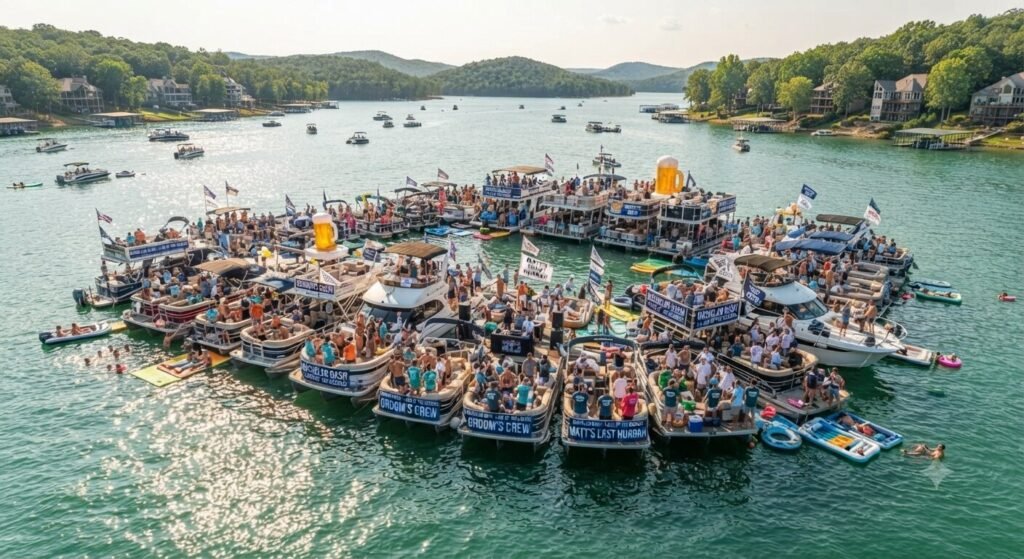
floating bar setup next to anchored boat Lake of the Ozarks
Guides

How to Arrange a Floating Bar Setup Next to Your Anchored Boat at Lake of the Ozarks

A floating bar changes everything about a swim stop. Your group is in the water. Drinks are floating right beside them. Nobody needs to climb back onto the boat. The party energy stays consistent. The swim stop that was supposed to last 45 minutes stretches naturally into two hours because nobody wants to leave. At Lake of the Ozarks, floating bar setups are a genuine tradition. At Party Cove near Mile Marker 26, they are practically expected. Groups that know LOTO arrive with a plan. They know what equipment to bring, how to secure it properly, and how to run it safely for the full swim stop window. This guide covers the entire process. What to buy. How to set it up. How to tether it correctly. What drinks work best. And the safety rules that keep the experience exactly what it should be. What a Floating Bar Is and Why It Works So Well at LOTO A floating bar is simply a drink station that floats on the water surface beside your anchored vessel. It can be as basic as a foam pool float holding a single cooler. It can be as fully featured as a purpose-built inflatable bar platform with built-in cup holders, a full-sized cooler, and enough room for six or seven people to stand in the water around it simultaneously. The concept works so well at Lake of the Ozarks for a simple reason. The lake experience is centered on being in the water. A floating bar keeps the social experience in the water with your guests rather than pulling them out of it every time they want a drink. It removes the constant interruption of climbing back onto the boat. It creates a central gathering point in the water where conversation flows naturally and the group stays together longer. At locations like Party Cove at Mile Marker 26, a well-set-up floating bar is what separates a memorable LOTO swim stop from an average one. Groups that arrive with a properly arranged floating bar become the social anchor for the entire area. Choosing the Right Equipment | Platform, Cooler and Accessories Getting the equipment right is the foundation of a successful floating bar setup at LOTO. The wrong platform creates instability. The wrong cooler allows ice to melt too quickly. Missing accessories mean guests are constantly improvising. The float platform is your most important purchase. The simplest option is a standard foam pool float or a flat inflatable swim platform. These are inexpensive and widely available. They work adequately for a small group with a single medium cooler. For groups of ten or more, they are simply not stable enough. They flex and rock under the weight of a full cooler plus leaning guests, and they are difficult to tether securely because they lack dedicated tie-off points. A purpose-built inflatable bar platform is the better choice for any serious LOTO floating bar setup. These are available from water sports brands including Intex, Airhead, and similar marine lifestyle suppliers. They come with built-in cup holders along the rails, molded handles at multiple tie-off points, stable flat surfaces designed to hold a cooler securely, and weight ratings typically between 300 and 600 pounds depending on size. A mid-range platform in the 400-pound weight rating range handles a full-sized cooler plus the leaning pressure of several guests without buckling or riding too low in the water. For a group of 12 to 20 people, a large-format platform keeps the cooler stable and gives everyone comfortable access from the water without crowding at one end. Your cooler choice matters more than most people expect. A hard-sided cooler with a secure latch or snap-down lid is the correct choice for a floating bar. Soft-sided coolers and open-top coolers perform poorly on a floating platform. Light chop from passing boats causes water to splash over the edge and into an open cooler, diluting the ice rapidly and warming your drinks faster. A 40 to 55 quart hard cooler with a positive-seal lid is the right capacity for most party groups at LOTO. It holds enough drinks for a full two to three hour swim stop without being too heavy to manage during setup. Always secure the cooler to the platform with a clip strap or a short bungee cord looped through the cooler handle and attached to a platform handle. This prevents the cooler from sliding off the platform if a guest grabs it unexpectedly from the water. For accessories, floating foam cup holders that clip onto the platform rail are essential. They keep canned and bottled drinks upright and accessible while guests stand in the water without needing to hold their drink constantly. Most purpose-built platforms include a set of built-in cup holders, but bringing extras is always a good idea for larger groups. Lidded plastic tumblers with sip openings work well for any mixed drinks or blended beverages that cannot go in a standard cup holder. A small floating snack tray tied to the platform with a short cord handles chips, fruit, and light snacks without requiring a separate float. Keep a compact trash bag secured to the vessel stern cleat to collect empties throughout the swim stop. This keeps the platform clean and prevents litter from entering the water, which is a legal requirement on Lake of the Ozarks under Missouri State Water Patrol environmental regulations. Setting Up, Tethering and Stocking the Floating Bar Setup sequence matters. Doing steps out of order wastes time and creates problems that are harder to fix once guests are in the water. Start by confirming the anchor position with the captain before you deploy anything into the water. The vessel must be fully stationary and the anchor must be holding before any equipment goes in the water. A vessel that shifts while the floating bar is deployed can jerk the tether lines and drag the platform into an unintended position or into swimmers nearby. Once the captain confirms the anchor is set,

Guides

Best Coves in Lake of the Ozarks for Clear Water Swimming and Snorkeling

Best Coves in Lake of the Ozarks for Clear Water Swimming and Snorkeling Most people never find them. The locals who know keep quiet about them. But the hidden coves of Lake of the Ozarks are some of the most breathtaking swimming spots in the entire Midwest, and once you experience one, you will never go back to the crowded main channel again. This is your complete guide to finding them. Lake of the Ozarks stretches over 1,150 miles of shoreline. It has more coastline than the entire state of California. Hidden within all of that shoreline are dozens of quiet, clear-water coves that most visitors completely miss. These are the spots where the water turns a deep, clean blue. Where you can see straight to the bottom. Where snorkeling feels like something you would do in the Caribbean, not the middle of Missouri. If you are renting a yacht or boat at Lake of the Ozarks, knowing where these coves are is the difference between a good day on the water and an unforgettable one. This guide covers the best coves for clear water swimming and snorkeling, how to find them, what to expect when you arrive, and everything you need to make the most of your time there. Why Lake of the Ozarks Has Such Surprisingly Clear Water Most people are shocked the first time they see the water quality in certain parts of Lake of the Ozarks. They expect a murky, muddy Midwest lake. What they find instead are sections of water with remarkable clarity and a rich blue-green color that looks almost tropical. The reason comes down to geography and water flow. Lake of the Ozarks is a reservoir fed by the Osage River. In the deeper, quieter coves that sit away from the main channel, there is far less boat traffic, less sediment disturbance, and better light penetration. These conditions combine to produce water that is noticeably clearer and more inviting than the busy main sections of the lake. The lake also has significant depth variations. In certain coves, the water drops quickly from a shallow, sandy shoreline into deeper, cooler sections below. This depth creates a layered, blue appearance from the surface that looks stunning in photographs and feels incredible to swim in. Water clarity at Lake of the Ozarks is best from late May through early July. During this window, algae growth is minimal, boat traffic has not yet reached its summer peak, and rainfall levels are typically lower. If you visit during these weeks and find the right coves, the swimming and snorkeling experience at Lake of the Ozarks genuinely rivals popular lake destinations that charge far more and require far more travel. The Best Coves for Clear Water Swimming at Lake of the Ozarks Grand Glaize Area Coves The Grand Glaize area sits near the 54-mile marker of the lake. This region consistently produces some of the clearest water conditions at Lake of the Ozarks throughout the summer season. The coves branching off from this stretch of the main channel are quieter than most. Boat traffic is lighter here compared to the more commercial sections of the lake near the 8-mile marker. Because of that reduced traffic, the sediment stays settled and the water remains noticeably cleaner. The shoreline in the Grand Glaize area is also less developed than other sections. More natural tree cover means less runoff into the water. This keeps the cove water cleaner throughout the season and gives the area a more remote, natural feel that is genuinely different from the resort-heavy stretches of the lake. For swimmers, the Grand Glaize coves offer a gradually deepening bottom that is perfect for wading in slowly before transitioning to open water swimming. For snorkelers, the rocky ledges in certain coves here host small populations of freshwater fish that are surprisingly interesting to observe up close. Ha Ha Tonka State Park Coves Ha Ha Tonka State Park sits on the western arm of Lake of the Ozarks. It is one of Missouri’s most unique natural areas and it sits directly on the water. The coves adjacent to the state park boundaries are among the most protected and least disturbed stretches of the entire lake. The water around Ha Ha Tonka has a distinctly different character from the main commercial sections of Lake of the Ozarks. It runs cooler. It runs cleaner. And in the right conditions, the underwater visibility here is exceptional. The geological character of this area also makes it fascinating for snorkelers. The Ozarks are limestone karst country. Underwater, that means rocky formations, ledges, and natural structures that create interesting terrain to explore. The combination of clear water and interesting bottom topography makes the coves near Ha Ha Tonka genuinely rewarding for anyone with a snorkel and a mask. Accessing these coves by boat is the ideal approach. You can anchor in the calm water just inside the cove entrance and swim freely without the current or boat traffic concerns that come with anchoring in the main channel. Gravois Arm Coves The Gravois Arm extends off the main body of Lake of the Ozarks and runs for several miles in a quieter direction away from the busiest resort areas. The coves along the Gravois Arm are consistently praised by local swimmers and boaters for their water clarity and peaceful atmosphere. This arm of the lake sees significantly less jet ski and high-speed boat traffic than areas closer to Osage Beach. That reduced disturbance keeps the water calmer and clearer throughout the day. Early mornings on the Gravois Arm feel almost completely serene. The water is glass-flat. The clarity is at its peak. And the coves are virtually empty. For snorkeling specifically, the Gravois Arm coves are ideal because the calmer water conditions make it much easier to see beneath the surface without waves and wakes constantly disrupting your visibility. The freshwater fish populations in this area are also more active and easier to observe than in busier

Guides

Professional Photography Tips for Posing on a Luxury Boat Swim Platform at Lake of the Ozarks

Everyone on that yacht looked amazing. You were there too. But your photos? They told a completely different story. That one frustrating truth is exactly why this guide exists. Posing on a luxury boat swim platform sounds simple. But there is a reason some people walk away with breathtaking photos every single time, while others get nothing but awkward angles and wasted shots. The difference is not the camera. It is not even the location. It is knowing exactly what to do the moment you step onto that platform. Lake of the Ozarks is one of the most photogenic spots in the entire Midwest. The deep blue water, the sprawling shoreline, and the luxury yachts make for an absolutely stunning backdrop. But a great backdrop alone does not make a great photo. Pose wrong, use bad lighting, or stand at the wrong angle, and even the most beautiful setting in the world will not save the shot. This guide fixes all of that. You are going to learn exactly how to pose, where to stand, when to shoot, and what to wear. Every tip here is practical. Every tip is proven. And by the time you finish reading, you will step onto that swim platform with total confidence and walk away with photos that genuinely look professional. Why the Swim Platform Is the Best Spot on Any Luxury Yacht Most people spend their entire yacht charter taking photos from the main deck. They never even think about the swim platform. That is one of the biggest photography mistakes you can make on a luxury boat. The swim platform sits right at water level. That single fact changes everything about how your photos look. When you shoot from the main deck, you get boat rails, life jackets, and equipment cluttering your background. When you shoot from the swim platform, you get open water, open sky, and nothing else. The result is a clean, cinematic composition that instantly looks more professional. At Lake of the Ozarks, this matters even more. The lake itself is the star of the show. The swim platform puts you right in the middle of it. You are not looking down at the water from a railing. You are standing above it, surrounded by it, and the camera captures all of that natural beauty around you. There is also the reflection factor. At water level, the surface of the lake acts like a mirror. When the light hits it right, your photos gain a depth and dimension that you simply cannot get from higher up on the boat. Photographers spend years chasing that kind of natural light. On a swim platform at Lake of the Ozarks, it is available to you every single time you step out there. The Golden Hour Rule That Changes Every Photo Ask any professional photographer when to shoot outdoors and they will give you the same answer every time. Golden hour. Without exception. Golden hour happens twice a day. Once just after sunrise. Once just before sunset. During these windows, the sun sits low on the horizon. The light becomes warm, soft, and directional. It wraps around your face and body in a way that midday light simply cannot replicate. Shadows become gentle. Skin tones look richer. The water behind you glows. At Lake of the Ozarks, golden hour is extraordinary. The way the late afternoon sun reflects across the water creates a natural warmth that makes every photo look like it was taken on a professional set. If you have the option to schedule your yacht charter around this window, do it. It will be the single best photography decision you make. Midday light, on the other hand, is your enemy. When the sun is directly overhead, it creates harsh shadows under your eyes, nose, and chin. It washes out colors. It makes the water look flat. If you are stuck shooting during midday, position yourself in open shade or use the natural shadow of the yacht’s canopy to soften the light. Overcast days are actually a hidden blessing. Cloud cover acts as a giant natural diffuser. It spreads light evenly across the entire scene and eliminates harsh shadows completely. Many professional photographers actually prefer shooting on lightly overcast days for portraits. If your charter day is cloudy, do not be discouraged. Your photos may actually turn out better than a sunny afternoon session. How to Stand on a Swim Platform Like You Own It The biggest mistake people make on a swim platform is standing perfectly straight and stiff. It looks unnatural in photos. It looks uncomfortable. And it immediately kills the luxurious, relaxed energy that a yacht charter is supposed to convey. Confidence in photos comes from body language. And body language on a boat has its own specific rules. Start with your weight. Never stand with your weight evenly distributed on both feet. Shift your weight onto one hip. This creates a natural curve in your body and makes your posture look relaxed and effortless. Combined with the open water behind you, this single adjustment transforms the energy of a photo completely. Turn your body at a slight angle to the camera. Standing directly face-on to the lens makes you look wider and flatter. When you angle your body between 30 and 45 degrees, you create a natural slimming effect and add dimension to the shot. Your shoulders should be turned slightly away from the camera while your face turns back toward it. This is the pose that models and influencers use constantly, and it works just as well on a boat as it does on a runway. Your arms are one of the most common problem areas in boat photography. When your arms hang straight at your sides, they press against your body and look awkward. Instead, create space. Rest one hand on your hip. Let the other hand hang loosely at your side with a slight bend at the elbow. If you are wearing a cover-up

Scroll to Top